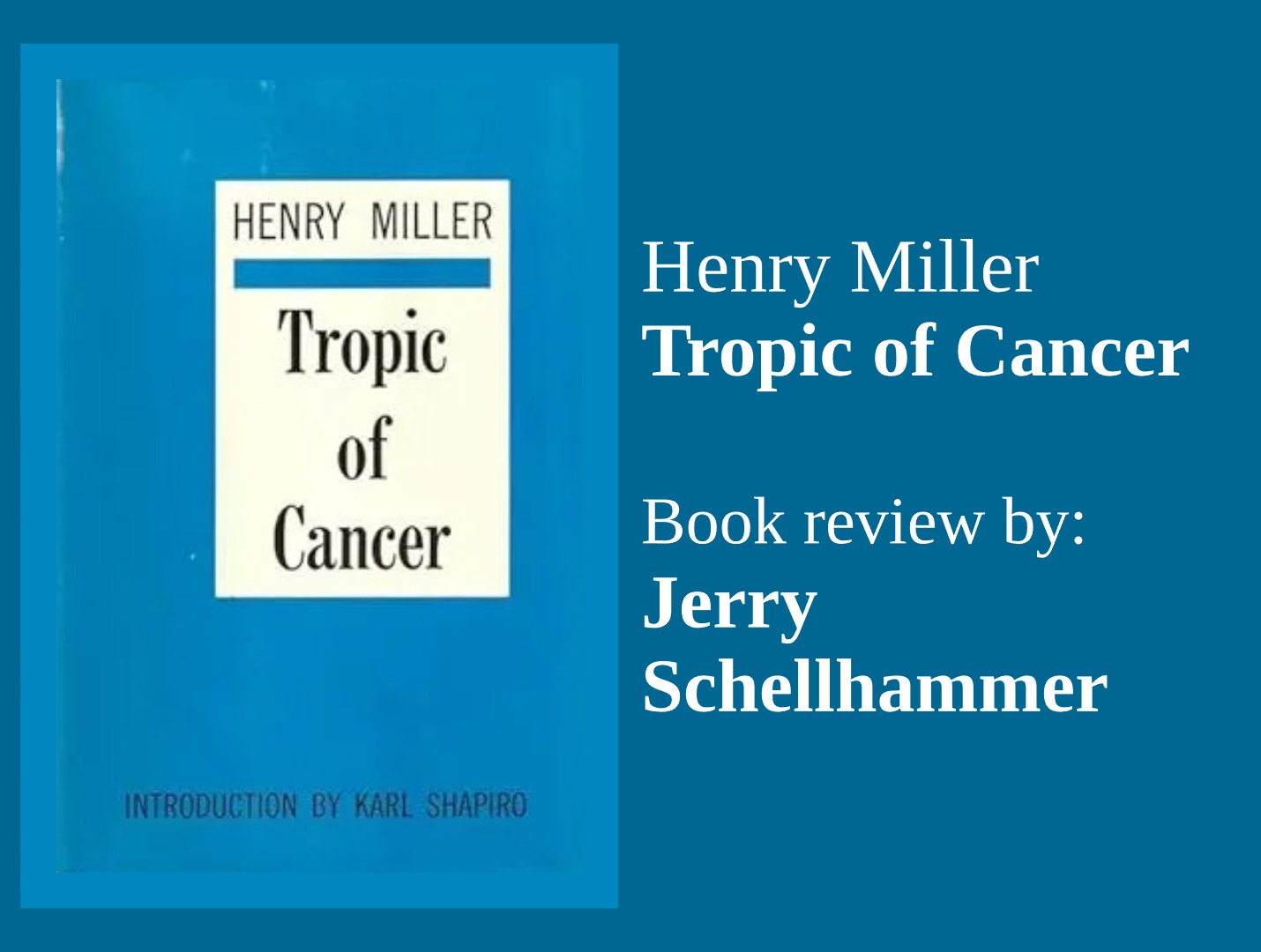
Sometime back just before Christmas I saw an article about Henry Miller’s Tropic of Cancer. The article made me curious about what exactly made this book so great. I remember my college professors pushing “masterpieces” down our collective throats. Most, such as Adventures of Huckleberry Finn, were indeed great books worth reading and I was dismayed that libraries wanted this book banned because certain words were used so freely.
So, I began reading this book from my Kindle. I had to weed through a personal critique of a reviewer, Karl Shapiro was his name; he was all agog about Henry Miller’s prose and style. I honestly was not impressed by this reviewer who I began to suspect might had some illusions of romance in his praises of Henry Miller.
Ayn Rand also put in her two bucks worth telling us how great a writer Henry Miller was and how he realistically portrayed his experiences in Paris in the 1930s. So, my judgement was already soiled by these two prologues prior to actually reading the story and making my own judgements.
So, I began reading of this starving writer who described Paris, its life, and lifestyles as “the Paris of Maugham, Gauguin, Paris of George Moore.” Then he shares the realities that is Paris or was Paris in 1934. It is a Paris of filthy streets in the dead of night, of prostitutes, pimps, and thieves. As he explained his experiences, there he sees no difference from New York City where he escaped to find his artistic self.
While I agreed with Ayn Rand on his descriptive realities of the least savory aspects of Paris, I can also see why many bookstores and libraries refused to display this book on their shelves. It is for all intents and purposes a treatise of immorality and obscenity. While Miller does not expand on his sexual escapades by showing his descriptions for all to read, by early twentieth century standards, it is easy to see why many people felt offended by this book.
There are episodes of insight that he placed in that caused me to think and wonder, humorous incidents such as the Indian émigré who mistakenly used the Bodet as a toilet.
For the most part Miller’s experiences while insightful and profane, is not I think worthy of greatness. There was more telling the reader rather than describing or showing. I read better masterpieces by Hemingway—For Whom the Bell Tolls, Fitzgerald—The Great Gatsby, or Mark Twain—Huck Finn. Those books are timeless, relevant today as when they were written. Tropic of Cancer does not rate in that category. It is neither timeless nor relevant in today’s society. Certainly, there are still women and men working the streets of Paris, or any other city in the world, struggling writers trying to make a living as best he or she can, and friends or pretend friends who take advantage of one’s charity or circumstance to advance themselves to make them look good.
I don’t know how Tropic of Capricorn rates in comparison seeing I never read that book either, but if it is anything like the book I just read, I probably won’t read that either. I wasn’t as impressed by his word craft as I was with those other three writers and their books I described above.
 Jerry Schellhammer