America’s Energy Future

In an episode of Paramount’s Landman, Billy Bob Thornton’s character, West Texas oilman Tommy Norris, sharply criticizes renewable energy while walking through a wind farm. He claims that it would take twenty years for a wind turbine to offset the carbon footprint created by its construction, but available data suggests that figure is closer to several months. The scene raises a larger issue worth discussing: America’s energy future should not be framed as a fight between fossil fuels and renewables, but as a practical transition in which each sector must adapt, cooperate, and contribute to a more reliable and sustainable grid. 

That practical transition begins with acknowledging two realities at once: renewable energy is now a permanent part of the American energy landscape, and oil and gas will continue to play a significant role for years to come. Coal, however, appears to be on a different path; like the ancient forests from which it formed, its place in the nation’s energy mix is steadily fading. It now accounts for just fifteen percent of U.S. energy consumption, and its long-term decline continues. 

Solar energy illustrates why this transition matters. While panels, batteries, electric vehicles, and other technologies still depend on materials, manufacturing, and reliable charging infrastructure, the resource itself is abundant: the amount of solar energy reaching Earth in about an hour is more than enough to meet global energy needs for an entire year. 

That abundance also matters because transportation electrification will place new demands on the power grid. Electric vehicles show how quickly clean-energy technologies can mature once investment, infrastructure, and consumer demand begin to align. Over the past decade, EVs have emerged as a viable alternative to internal combustion engine vehicles, despite early limitations in battery capacity, charging speed, and driving range. Rather than comparing every vehicle type as if it served the same purpose, the broader trend is clear: battery capacity, range, and efficiency have improved significantly across hybrid, plug-in hybrid, and fully electric models. EVs now come much closer to matching conventional vehicles in everyday performance, even though charging access, grid capacity, and battery supply chains still require continued development. 

Hydroelectric power is especially meaningful to me because of my lifelong connection to the Pacific Northwest, where rivers and dams have long shaped the region’s identity and economy. Hydropower was America’s first major source of renewable electricity, predating the modern growth of wind and solar. Its flexibility and dispatchability also make it a valuable partner to variable renewables, helping create a more reliable and resilient grid. 

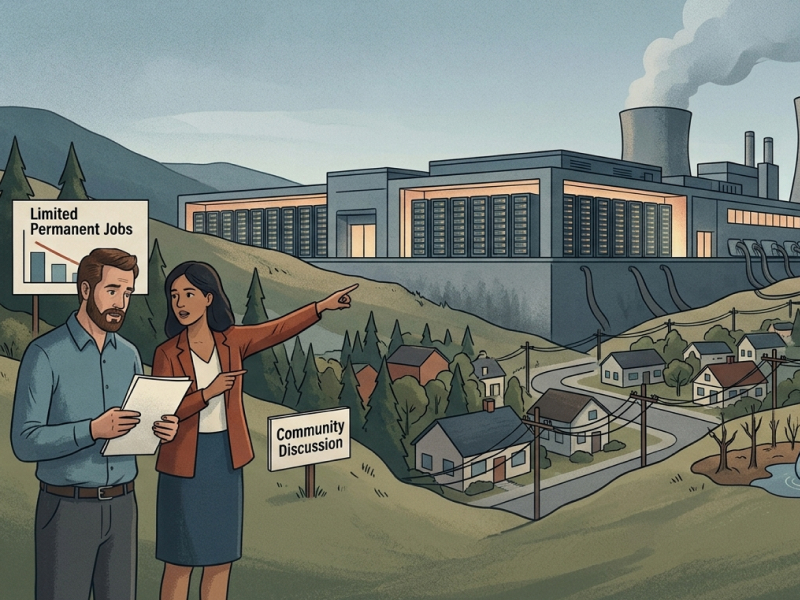
Those who view renewable energy primarily as a threat to traditional energy jobs should instead recognize it as an opportunity for adaptation and investment. The relationship between fossil fuels and renewables is increasingly interconnected: solar arrays, wind farms, hydroelectric dams, transmission lines, vehicles, machinery, and maintenance systems all depend on skilled workers, reliable materials, and industrial support. Given the growing strain on the electrical grid, the better path forward is cooperation rather than competition—an energy economy in which all sectors contribute to greater reliability, stronger domestic production, energy independence, and long-term sustainability. 

Some People Never Learn

Perhaps it was because it’s my Monday. After all, I left my phone where I laid it on the dining table on my trailer with every intention to pick up on the way out the door. But something distracted me again and it sat on that table where I left it. 

Anyway, I get to work and of course that’s when I realized the phone isn’t in my shirt pocket where I normally put it when I’m not distracted. 

I then clock in, sign in, and see where I’ve been assigned. Restrooms and so I go about getting that set up and continue to do my restrooms, hopeful of a nice and quiet day. It’s forecasted for very hot weather today, in July no less. Who would have thought? 

Anyway, most of the restrooms are reasonably clean this time and I do what I can to make them shine more and go on to the next. At the second to last restroom before my break, I see what looked like a black backpack lying on the floor. I merely glanced at it and figure the owner is in the stall doing his personal affairs, so I continue with my work. I don’t think anymore of it as I move to the urinals and slowly make my way to the furthest stall where the “pack back” lays. I’m still ignoring the object on the floor until I finished the last urinal and turn around. 

To my knowledge packs don’t have long black hair and a black hoodie sweatshirt. He appeared passed out, or worse. I didn’t have the courage or the expertise to find out and immediately called my supervisor, but she wasn’t answering. Thinking I might not be on the correct channel—some radios are used in the outdoor concert venue—I got another coworker to call her and tell her what’s happening. 

Five minutes later one of the security officers shows up strolling at a casual gait with not a care in the world. I’m not panicked but a little concerned by his lack of hustle. After all, I’m only assuming the worse here, that he might be another statistic on the fentanyl OD train. 

“What’s the problem?” He asked slowly as though he had all the time in the world. 

“He’s passed out on the floor at the end stall,” I replied trying to maintain a semblance of calm myself. I followed him into the restroom, and he beats on the door.  

Nothing. 

“Security, open up please.” 

Nothing. 

He unlocks the door with his fingernail and opens it. 

Nothing. 

“Hey, wake up.” He shakes him.  

Nothing. 

Another security officer comes in and assesses the situation. 

“I’m not liking this,” I announced with an edge of concern and fear in my voice. 

“Security to Dispatch we’re needing EMTs here stat,” the first officer tells the dispatcher on the other end of the radio.  

“I’m going to block the restroom,” I stated as I move as quickly as my disabled feet can go, push the restroom cart out to the entry way, and turn it just so to keep people out. 

I don’t know if it’s just me or if it seemed like there was no urgency to this situation. The EMS came loaded on a gurney with their equipment as if on a stroll on a winding trail. 

They stopped at the restroom entry, and they grab a couple items on the gurney and go inside. Then the urgency kicked in like a mule kick. The woman EMT runs out and grabs the third bag. That’s the one with the Narcan and runs back inside while at the same time calling in the cavalry—fire department and ambulance—to get this person out of here before she have to draft another report that no one wants to write. 

I’m still out-front telling men there are other restrooms they can use just not this one right now. “It’s a medical emergency,” I told them. 

“A what?” As if my use of those three words are completely alien to them. 

“It’s…a…medical…emergency,” I pronounced slower. 

Tribal Gaming Authority people show up and take charge of the situation inside while I continue waiting for the rest of the party to show up. I hear the voices inside urging this guy to wake up and when he finally does come to, police, ambulance and fire department show up at the same time and now the customers who were even paying any attention at all to this drama, take notice. At least this portion of the casino are abuzz with all manner of questions and curious looks. 

Finally, he’s brought out escorted by three police officers in handcuffs. The gurney is too wide and the entry meanders around like one of those seashells that circle about. In my old age I can’t remember. I know I’ll ask Google. They know everything. Planispiral gastropod, that’s it. 

Anyway, they put this long-haired guy who looks totally gassed on this gurney and cart him to the waiting ambulance outside. 

There was another situation but that can wait another day. The title of this tale speaks for itself. After all, he’s an addict who looked like he doesn’t want to change his lifestyle. For him he just sees life as an empty vessel and death as an easy escape. 

Key Themes 

  • Urgency versus complacency: The narrator repeatedly notices a gap between the seriousness of the emergency and the slow, casual response of others, creating tension throughout the scene. 
  • The unpredictability of ordinary workdays: What begins as a routine restroom assignment quickly turns into a crisis, showing how sudden and unsettling everyday life can become. 
  • Addiction and self-destruction: The unconscious man becomes a symbol of addiction’s destructive cycle, especially in the narrator’s final reflection on lifestyle, emptiness, and escape. 
  • Responsibility in crisis: Even without medical training, the narrator takes practical action by reporting the situation, blocking the restroom, and directing customers away from danger. 
  • Frustration with public indifference: Customers’ confusion and curiosity highlight how people can treat emergencies as interruptions or spectacles rather than serious human situations. 
  • Dark humor and personal voice: The narrator balances anxiety with dry humor, casual digressions, and blunt observations, giving the piece a distinctive conversational tone. 

BLAMELESS 

The street had gone quiet enough for her to hear her own breath. She noticed the man only after she crossed beneath the weak cone of a streetlamp—a dark shape half a block behind her, moving when she moved, stopping when she slowed. She crossed the road without looking back too quickly, willing herself not to run. His footsteps crossed after hers. She noticed him following her from the bus stop on Wellsley a block away. 

Her pulse kicked hard against her throat. She risked a glance over her shoulder and saw him pause at the corner, his face hidden beneath the brim of his hat. For one blessed second, he turned down another street. She stopped, pressed a hand to her chest, and drew in the cold night air of Mid-April until her breathing steadied. 

She made herself walk again. In the next pool of light, her features appeared and vanished: a young professional in a long dark jacket, hat pulled low over dark hair, jaw set tight against fear. Her heels of her practical and comfortable shoes echoed against the pavement, seemingly too loud in the silence. 

Then came the sound of boots behind her, close this time, gravel grinding beneath each step. She turned, and the scream caught in her throat as a strong, vise-like hand closed around her neck. The last thing she saw was a pair of black eyes and a crooked smile cutting across a grotesque appearing face, but she knew him. 

By dawn, the quiet Wabash Street had become a crime scene a washed in blue and red lights. Six-foot four inch Mark Marteau and all of five foot two inches of Agent Anne Murphy stood over the body of a young woman with livid marks around her throat and broken capillaries reddening her eyes. Her long jacket hung open. The front of her business dress had been torn, and the cold air seemed to make the violence against her feel even more deliberate. Crime scene investigators from Spokane’s Major Crimes Unit moved around them with cameras, evidence markers, and clipped voices. 

It was Mark’s fourth homicide case and Anne’s second. He crouched first, scanning for what did not belong. He wore his signature double-breasted charcoal pinstripe suit with brown fedora from a bygone age. Anne had a page boy hair cut that complimented her Navy FBI jacket and dark slacks lowered herself beside him, careful not to crowd the medical examiner. She had once taught literature in a parochial school as Sister Anne. Now she wore an FBI badge and latex gloves, and Mark still had not decided what to do with either fact. Then he noticed the carved reference above the victim’s bra. “Wait,” he said. “Job 9:22?” 

Anne followed his gaze. The medical examiner caught it too and touched the sleeve of the technician taking photographs. “Agent Marteau, it’s a verse from the Bible—from the Book of Job.” 

“Okay, Sister,” Mark said, eyes still on the wound. “What does it mean?” 

She gave him a look over the top of her gloves. “I’m not that anymore, sir. To answer your question, I’ll quote it for you: ‘It is all the same; that is why I say, 

‘He destroys both the blameless and the wicked.’ 

23 When a scourge brings sudden death, 

he mocks the despair of the innocent. 

24 When a land falls into the hands of the wicked, 

he blindfolds its judges. 

If it is not he, then who is it? ‘ 

Mark looked from the verse to his partner. “He’s blaming God?” 

“Job is in despair because his life has fallen into ruin,” Anne said. “He blames God for suffering that feels undeserved.” 

“I know the story—the wager, the test of Job’s righteousness.” Mark straightened slightly, still studying the body. “You think this perp sees himself the same way?” 

Anne nodded. “Maybe. If he believes he has been righteous and still suffered, he may see the world as rigged against him—good and evil punished the same, innocence mocked, judgment blind.” 

“But why her?” Mark wondered. “Could he be mistaking her for a prostitute?” 

“It’s hard to say. This doesn’t match the serial killer the police are looking for. That killer uses a knotted rope, usually targets teenage girls, and has never marked a victim with scripture.” She watched as the medical examiner helped technicians ease the body into a bag and zip it closed. “And these marks are from hands, not rope. Large hands.” 

“Yeah,” Mark replied. “Huge.” The body was lifted onto a gurney and wheeled toward a black panel van marked Spokane Special Crimes in white paint. The rear doors opened, swallowed the stretcher, and closed again. 

“When do we get the autopsy report?” Anne asked as they walked toward the Dodge Intrepid Mark insisted on using. 

“When they call us, I guess.” Mark looked back once at the taped-off street. “Anything else from the initial assessment?” 

“Only that she doesn’t read like a random victim,” Anne said. “She looks like a business professional—maybe even a lawyer. Someone with authority. Someone who could make an enemy.” 

“Targeted, then,” Mark said. “Let’s talk to Howard.” 

“He would know, being a profiler and all,” she replied. She sat in the passenger seat and waited for Mark to get in. “I want to know his thoughts on the Bible verse. That has to be the key to whoever this unsub is.” 

He put the car in drive and steered around the flashing blue and red lights of the Ford Crown Victorias. He seemed to be chewing on what she had said. “It’s personal. He knew her.” 

“It does appear that way. She crossed this person somehow.” 

Mark nodded as he checked his mirrors briefly. “The police have her license. I’ll get her positively identified, find out where she worked, and see whether her job has put her in conflict with anyone recently. If the verse is about blame, then we’re looking for someone who thinks she judged him, failed him, or exposed him.” He glanced at Anne, the sarcasm gone for once. “That was a good catch.” 

“Howard, we need your eyes on something,” Mark said, handing over his notes to the FBI profiler with the wicked mutton chops. “This is what we saw at the scene.” 

Howard accepted the pages and read them at his desk, one finger tapping beside the line about Job 9:22. Chester and Hector were still undercover on another case. “Where’s Anne?” he asked. 

“Restroom,” Mark said. “That Bible verse bothers me.” 

“It should,” he replied in his distinct New England dialect that reminded Mark of Harvard-Yale football games in autumn. Howard looked back at the notes. “A public attack might be opportunistic. A verse carved into flesh is not. That suggests anger with a message attached—punishment, accusation, maybe retribution.” He looked up with a faint smile. “Carol called five minutes before you arrived. She has the same question about the verse. I told her we had someone here who could do more than guess.” 

“Did she disclose the victim’s identity?” 

Howard nodded in the direction of where Anne was returning. “Dr. Susan Clark, a psychoanalyst at Eastern State Hospital. “We were discussing this verse, Agent Murphy.” 

Anne walked in and sat on Hector’s swivel chair. “Job says he is blameless even as disaster overtakes him. Then he turns that despair outward. If the innocent and wicked suffer the same fate, he asks what kind of justice governs the world.” 

Howard nodded slowly. “So, the unsub may identify with Job—not as a sufferer seeking mercy, but as a man insisting he has been wronged.” 

Mark glanced at Anne. “And being as you were a nun…” 

“Former nun,” she corrected. “And yes, I see where you’re going. Job is not simply complaining that life is unfair. He is wrestling with a terrifying idea: that suffering may strike the righteous and wicked alike. A killer could twist that into grievance—if no one is truly protected, then why should he be restrained?” 

“In the story, the test exposes the danger of pride as much as suffering,” Anne continued. “Faith is not supposed to make a person superior to everyone else.” 

“Pride, grievance, entitlement,” Howard said. “That combination can become combustible. A person like that may see himself as blameless in every failure, then assign guilt to anyone who challenges him.” 

“So, is he mentally ill?” Mark asked. 

Howard’s expression tightened. “Maybe. Maybe not. Don’t use diagnosis as a shortcut.” 

“I’m asking whether we should look for a psychiatric history,” Mark said. 

“Before that,” Anne said, “we should not assume the offender is male just because the scene feels brutal.” 

Mark gave her a look. “The handprints say large.” 
“Large does not always mean male,” Anne replied. 
Howard raised a hand before they could keep sparring. “The hand size, force used, and victimology make a male offender more likely, but Anne is right about the principle. We follow indicators, not assumptions. As for mental illness, look for documented crises, threats, medication disruptions, or recent contact with the victim. Do not assume a diagnosis explains violence.” 

“Then what does the verse tell us?” Mark asked. 

Howard leaned back. “That the victim meant something to him. He wanted whoever found her to understand his complaint. He did not just kill her. He argued with her after death.” 

“Can you give us a baseline profile?” Anne asked. 

“A preliminary one,” Howard said. “Likely male, late twenties to mid-thirties, physically strong, and personally connected to the victim. The hand marks suggest size and control. The scripture suggests grievance. The method suggests this was not the serial offender Detective Marcus has been chasing. Her killer wanted contact. He wanted her to know he was there.” 

“She’s still on that guy, ain’t she?” Mark asked. 

“Are those the cold-case murders?” Anne asked. 

“Only the ones involving young girls strangled with a knotted rope,” Howard said. “Different victim type, different method, different message. This scene is personal.” 

“Where do we start?” Mark asked. 

“With her work,” Howard said. “Find out who she treated, opposed, reported, or threatened professionally. If there is a psychiatric history, it only matters if it intersects with Dr. Clark—recent crisis, documented threat, medication lapse, discharge dispute, complaint, anything like that. Detective Anthony is already checking the local side.” 

Mark nodded once. “Then we start with Eastern State.” He looked at Anne. “Come on, Agent Murphy. Let’s take a drive to Medical Lake.” 

Dr. Sullivan received Mark and Anne in an office that looked too orderly for the man sitting behind the desk. Patient files were stacked in precise columns, diplomas hung in heavy frames, and the doctor himself seemed frayed at the edges—red hair thinning, collar tight, fingers worrying the arm of his leather chair. “What can I do for you?” 

“Information,” Mark said. He did not sit right away. Instead, he let his gaze move over the room before returning to Sullivan. “A young woman was murdered in Spokane last night. We’re trying to identify anyone recently connected to her who may have had a grievance.” 

Sullivan’s posture stiffened almost imperceptibly. “I see. You understand that patient records are protected under HIPAA and state confidentiality laws. Without a court order, warrant, subpoena, or a narrow emergency exception, I cannot disclose patient files. The physician-patient relationship, like attorney-client privilege or clergy-penitent confidentiality, is not something I can disregard because law enforcement asks.” 

“We’re not asking you to disregard it,” Anne said. “We’re asking whether the description means anything to you. The victim appears to have been a professional woman, possibly a doctor or lawyer. The evidence suggests the killer felt personally judged, betrayed, or exposed by her in a professional setting.” She watched his hands instead of his face. “Does that ring any bells?” 

“And if we need a warrant, we’ll get one,” Mark added. “But if a dangerous former patient is walking around because nobody wants to say his name, that becomes a different conversation.” 

A knock struck the door with a loud and urgent rapping. “Come in!” Dr. Sullivan announced. 

A young male nurse entered and leaned close to Sullivan’s ear. Whatever he whispered drained the color from the doctor’s face. 

Sullivan stood too quickly. “I’m afraid this meeting is over, sir, ma’am.” 

“Is there something wrong?” Agent Marteau asked. 

“No,” Sullivan said, but the denial came too fast. “Nothing for you two to concern yourselves with.” 

Anne held his gaze. “Was it about the woman discovered in Spokane near North Perry?” 

“What?” Sullivan’s hand tightened on the back of his chair. “How did you know that?” 

Mark glanced at his partner in surprise. “Who was she?” 

“Dr. Susan Clark,” Sullivan said at last. “She was one of our lead psychiatrists.” He moved to the door and opened it. “Now, if you’ll excuse me.” 

“We’ll be back with a warrant,” Mark said as he passed him. 

Sullivan’s grief flared into anger. “Have you no shame? A colleague is dead, and you have the insensitivity to threaten me in my own office?” 

Mark turned back. “I’m going to solve this murder. If it turns out you knew who could have done it and hid behind policy while another victim was at risk, obstruction will be the least of your problems.” He left Sullivan red-faced in the doorway. Anne followed without apologizing for him. Outside, she made sure Mark saw the look on her face. 

“Mark, wait.” She caught up as he shoved through the entry doors into the chill outside. He stopped, impatient and angry. 

“We need the warrant before he locks those files down, sanitizes his notes, or decides what story everyone here is going to tell.” 

“I understand the urgency,” Anne said, keeping her voice level. “But he just learned a colleague is dead. Shock can make people hesitate, not act. We have time to do this properly. If we go in angry and sloppy, he will use that against us.” 

Mark stared toward the hospital entrance, jaw working. “Okay,” he said after a beat. “Properly. But I want Clark’s patient files, complaint notes, and any related recordings before that man has time to breathe on them.” He tossed her the keys. “You drive. I need to draft the affidavit, and have a warrant from our district court judge, Brandon.” 

“Federal court? Mark, this is still a local homicide. Shouldn’t we seek a warrant from a county superior court judge?” 

They switched seats. Mark folded himself into the passenger side and pulled out his BlackBerry. 

“County superior court,” Anne reminded him as she started the car. 

“Yeah,” he said, already stabbing at the tiny screen with the stylus. “You’re right. Superior court. Evidence first, affidavit second, righteous indignation later.” 

Anne pulled into a law-enforcement space outside the courthouse just as Mark sent the last draft of the affidavit from his BlackBerry. He was out of the car before the engine settled, moving with the fixed purpose of a man who believed delay was another suspect. 

“How did you know what the nurse told Sullivan?” he asked. 

Anne kept pace beside him. “I heard him say Susan was dead.” 

“Remind me never to whisper around you.” Mark pushed through the clerk’s office door just as a middle-aged woman with permed brunette hair looked up from the printer. 

“You’re a little early, Agent,” she told him in a midwestern drawl. 

“I was in transit and sent the affidavit less than a minute ago.” Sheila smiled, stamped the paperwork received, and called chambers. 

“It’s Sheila Monroe. I have an affidavit packet for Judge Lee. Thanks.” 

She hung up and pointed down the hall. “His clerk will take it up. You can wait outside chambers.” 

A younger woman appeared, took the affidavit packet, and started toward the stairwell. Mark was already moving. “Let’s go.” 

They climbed to the second floor and stopped at the desk outside a closed door marked Judge Stan Lee. The same clerk glanced up from the packet and smiled. “He’ll see you now, Agent Marteau.” 

“Thanks,” Mark stated as he strolled to the door and knocked. 

“Come in,” an elderly voice called. Mark and Anne entered and closed the door behind them. Judge Lee stood from behind his desk, white shirt sleeves rolled to his forearms, tie loosened. “Agent Marteau. And I don’t believe I’ve had the pleasure.” 

“Agent Anne Murphy, Your Honor.” She shook his hand briefly. 

“East Coast,” he said, hearing it in her voice. “Boston?” 

“Brookline Your Honor.” 

The judge returned to the affidavit. “I went to Harvard Law myself, though long enough ago that I no longer pretend to remember all of it. This is thin, Agent Marteau.” 

“Thin, but focused,” Mark said. “Dr. Clark may have been killed by a patient who believed she wronged him, or she may have uncovered misconduct inside the hospital. Dr. Sullivan’s reaction made him a person of interest, but I’m not asking him to search his office. I’m asking to preserve Clark’s current and recently discharged patient files—treatment notes, discharge objections, complaints, and related recordings—before anything disappears.” 

“I see, and what else are you going to do with those files?” 

Anne stepped in before Mark could oversell it. “Your Honor, the Bible reference and the victimology suggest a personal grievance. Dr. Clark’s current and recently discharged patients are the narrowest place to look for that grievance. If the records show nothing, we stop there. If they show a conflict or documented warning, we come back with more.” 

He raised his eyebrows. “But you just said you suspect another doctor,” he pointedly told Mark. 

“That part isn’t a hunch,” Mark said. “Agent Murphy recognized the reference. The killer marked the victim with Job 9:22.” 

“The entire verse?” the judge asked. 

“No, Your Honor, just where the verse came from,” Anne replied. “Job 9:22, Your Honor.” 

Judge Lee pulled a worn Bible from the corner of his desk and found the passage quickly. His expression changed as he read. “Does Sullivan know about this?” 

“No,” Mark said. “Agent Murphy tested the edges of it, but he didn’t react as if he knew about the verse.” 

Judge Lee closed the Bible and turned back to the affidavit. “I’ll authorize a narrow search of Dr. Clark’s current and recently discharged patient records, including treatment notes, discharge objections, complaint references connected to those patients, and related recordings identified in the affidavit. If this points to Sullivan or anyone beyond that scope, you come back before you broaden the search.” 

He turned the affidavit toward Mark. “Raise your right hand. Do you swear the facts in this affidavit are true to the best of your knowledge and belief?” 

“I do,” Mark replied. 

Judge Lee signed the warrant and slid it across the desk. “Search only for what I authorized. And document your chain of custody,” he added, handing it over. “I do not want to see this case fall apart because someone got enthusiastic.” 

“Understood, Your Honor.” Mark took the signed warrant. Outside chambers, he exhaled for the first time since they had entered. “I don’t know about you, but I’m getting hungry. Dolly’s before they close.” 

Anne pressed the elevator button. “Evidence first, lunch second.” 

Back at the office, Anne set the sealed evidence box on her desk as though it contained something fragile. Twenty current and recently discharged patient files sat inside, each one authorized by Judge Lee’s warrant and each one a possible bridge between Susan Clark’s death and the person who had wanted her silenced. 

She opened the first folder—Adams, Aaron—read the intake summary and began marking dates in her small black notebook: admission, discharge, medication changes, Clark’s notes, Sullivan’s signatures. Mark stood over her shoulder, hands in his pockets, watching as if skepticism alone might make the work go faster. 

“We could divide these,” she said without looking up. “Unless you plan to intimidate the files into confessing.” 

“I still think Sullivan is our man,” Mark said. “He reacted like a scared rabbit. Remember that priest at Holy Cross? Just like him.” 

Anne finally looked up. “And you are basing that on your gut?” 

“It has a strong track record.” Mark pulled a folder labeled Clark, William, skimmed the first page, and slid it back into the box. He took Dallas, Roger next, gave it the same impatient treatment, then reached for another while Anne was still building her timeline from the first file. 

“Skimming names is not reviewing evidence,” Anne said. 

“Look, we don’t have all day to map every medication adjustment and margin note.” 

“That is exactly where the motive may be hiding,” she said. “We need to know who Clark thought was unsafe to release, who Sullivan discharged anyway, and whether any of those decisions created complaints against him.” 

Mark paused with one hand on the box. “The most to gain,” he said, more to himself than to her. Then he pulled out his cellphone. “Detective Anthony.” 

“What do you want, Agent Marteau?” Detective Anthony asked, her voice carrying distinctly from Mark’s cellphone. 

“Did you interview Dr. Sullivan?” 

“No, he never came across our radar. Why, what’s up?” 

“Maybe nothing. Maybe the guy just looked guilty because he’s awkward and grieving. But if Clark’s complaints threatened his position, Sullivan had a reason to want her quiet.” 

The line went quiet long enough for Mark to imagine Carol searching her memory for something that would make his suspicion less irritating. 

“Mark, he’s clean. Where are you on those files you got from her office?” 

“Between you and Anne, I can’t seem to enjoy being unreasonable.” 

“Goodbye, Mark.” The line went dead, and Mark folded his phone, disappointment showing on his face. 

When the call ended, Anne returned Adams to the box and drew Howard, John. Howard Jones entered as she opened it, carrying coffee and the look of a man who expected to be entertained. The dwarf hopped up on a swivel chair and sipped from his cup. 

“Is there a problem, Mark?” Howard asked. 

“No,” Mark said, pulling another folder and barely opening it. “I’m just not enjoying the clerical portion of the murder investigation.” 
Anne set her pen down. “I’m not sure what you’re implying, sir.” 

“I’m implying that you still have that Academy glow. Every note matters, every box gets checked, every instructor’s ghost gets a gold star.” 

Howard sipped his coffee. “We all had that glow once. Some of us lost it under paperwork. Others buried it under sarcasm and poor posture.” 

Anne looked at Mark, not Howard. “If I stay on this case, I am going to work it correctly. I’m not going to pretend your instincts outrank evidence because you’re impatient with paper.” 

Mark stared at her, caught between irritation and something too close to respect to admit. Howard’s smile widened. Mark glared at him, then reopened the folder he had just dismissed. “Fine,” he muttered. “Evidence first.” 

The room quieted into the scratch of pens, the whisper of paper, and the occasional clack of a folder returning to the box. Howard took Peppers, Charles Oliver. Anne stayed with John Howard. Mark, grudgingly thorough now, opened Norman, John. 

After several minutes, Mark tapped the folder. “Norman, John. Dr. Clark documented bipolar disorder, recent instability, and improvement while he stayed on Aristada. Sullivan discharged him last week over her written objection.” 

Howard lifted his cup in salute. “Look at that. The file speaks when someone actually reads it.” 

Mark ignored him and kept reading. “Clark wrote that he was improving with medication support but remained vulnerable to decompensation if released without supervision.” 

Anne looked up from John Howard’s file. “If Sullivan released him anyway, then Clark’s note becomes a warning he ignored.” 

“And if Norman deteriorated after release,” Mark said, “Sullivan had a reason to resent the warning. It made him accountable.” 

“There’s your pattern,” Howard said. “Not just who could have killed her. Who benefits if the paper trail disappears.” 

Anne turned John Howard’s file toward them. “Same pattern here. Premature discharge over Clark’s objection, a medication-support concern, and a copy of a complaint against Sullivan. Clark wrote that discharge decisions appeared driven by bed pressure and funding concerns rather than patient stability.” 

Howard set down his coffee. “Two patients, two objections, two complaints.” 

“And one doctor in the middle,” Mark said. 

Anne closed John Howard’s file. “Then we verify before we accuse. We find Norman and Howard, confirm their status, and see whether the files match the people. If Sullivan is manipulating releases, the patients will tell us more than your gut can.” 

Mark checked the address page in Norman’s file. “John Norman is at a halfway house on West Third. Howard is listed at the VA Hospital.” He tapped the folders into a neat stack. “Norman first.” 

They left the cubicle and headed for the elevator bank. “You did good, probie,” Mark said as the doors opened and Hector Gonzales and Chester Smith stepped out in work boots, jeans, and contractor jackets—street clothes for an undercover OSHA assignment tied to a New Jersey construction company. Mark caught himself and added, quieter, “I mean it.” 

“Hey there, Sister,” Hector said warmly to Anne. Then he looked at Mark. “You two find the perp yet?” 

“Maybe,” Mark said, keeping it vague. “Come on.” He stepped into the elevator with Anne, catching Hector’s quizzical expression just before the doors closed. 

“You seemed standoffish,” Anne said. 

Mark shrugged. “He got the construction case with Chester. Mafia ties, OSHA cover, the whole thing. I got patient files and a Bible verse.” 

“Jealousy is one of the deadly sins, Agent Marteau.” 

“It is also human,” Mark grumbled as the elevator opened into the underground garage. He retrieved the keys from Pops and cut a straight line toward the Dodge Intrepid, which sat under the fluorescent lights like it had been waiting for him personally. 

Once they were inside and Mark had started the engine, Anne said, “So it is more about the Mafia connection than the shoddy work practices.” 

Mark stared at her, then nodded once. “Exactly. Hector gets a feather in his cap while I get…” 

“Me?” 

Mark winced. “That came out wrong.” 

“It usually does,” Anne said. “For what it’s worth, Hector did not complain when we worked together last year. He treated me like an agent.” 

“Then why does he get away with calling you Sister?” 

“Because he says it with affection. You say it like a verdict.” Anne looked through the windshield instead of at him. “I am Catholic. I was a nun. I am also your partner. If we’re going to work together, I need you to decide which fact matters most in the field.” 

The halfway house on West Third looked ordinary at first glance: brick walls, narrow front steps, a cement walkway split by weeds. Only the locked wrought-iron gate over the front door suggested how carefully the ordinary had been reinforced. 

Mark pressed the call button beside the gate. “Agent Marteau, FBI. We’re here to speak with one of your residents.” A moment later, the inner door opened and a black-haired woman in scrubs came out with a key ring. She unlocked the gate and gave them a practiced, cautious smile. 

“Who are you here to see?” she asked. 

“John Norman,” Mark replied. 

“Right this way,” she said. “Can you tell me what this is about?” 

“One of his doctors from Eastern State was found murdered,” Anne said. Her eyes moved to the locked gate behind them. “Is that secured all the time?” 

“Yes,” the nurse said. “Most residents are doing better than when they were admitted to Eastern, but some still need structure, medication support, and supervision. The gate protects residents as much as staff or neighbors.” 

“What if there’s a fire?” Mark asked rhetorically. 

“Every bedroom has an emergency window release tied to the smoke detectors and fire alarm,” she said. 

Mark and Anne exchanged a look but let it pass. The nurse stopped outside a closed bedroom door. “This is John’s room.” 

She unlocked it. Inside, John Norman sat on the edge of his bed, rocking forward and back, hands clenched around his knees. “John,” the nurse said in an overly bright voice, “these visitors would like to speak with you.” 

“I need my meds,” John said, the words coming out sharp and frightened. He did not look at the nurse. His vacant gaze settled on Anne. “Hi. I’m John. Do you have my Aristada? It’s the only thing that helps.” 

Anne lowered herself slightly, so she was not looming over him. “When did you last receive it, John?” 

His rocking slowed. “Two days ago? I can’t remember.” 

“He received his dose last night,” the nurse said quickly. “We administered it through the IV we set up.” 

Mark watched John resume rocking. “Is this typical for him?” 

“He can become agitated when routines change,” the nurse said. 

Anne kept her voice gentle. “How was Dr. Clark with you?” 

John blinked several times. “She was okay. I liked her.” 

Mark stepped in carefully. “And Dr. Sullivan?” 

John recoiled so hard the bed frame squeaked. “No, no, no. He wanted me to hurt her, and I told him no.” His eyes snapped to Mark. “I want my meds.” 

The nurse moved between them and John. “That’s enough for now.” 

“Agreed,” Mark said. He and Anne backed out while the nurse closed and locked the door. In the hallway, he looked at Anne. “You have the address for Howard?” 

“VA Hospital,” Anne said. “And I don’t like where this is going.” 

“What could possibly go wrong?” Mark asked, but the joke had less air in it than usual. The nurse led them back outside, unlocked the gate, and let them through. 

On the walkway, Anne stopped. “That was not your gut. That was a witness. John says Sullivan wanted him to hurt Clark, he refused, and now he is deteriorating after release. That makes Sullivan more than negligent.” 

Mark looked back at the locked door. “And you got him to say it without scaring him silent.” He opened the car door. “But Norman’s statement won’t carry this alone. We check Howard. If the pattern repeats, Sullivan’s running out of shadows.” 

“Then why was Norman released at all?” Anne asked when they got in. “He needs a higher level of care. And I do not believe he received that dose last night.” 

Mark said nothing as he drove. He took Third to Spokane Street, then Second toward Lincoln, the city sliding past in blocks of brick, glass, and early-afternoon traffic. By the time the VA Hospital rose ahead on Assembly Boulevard, the silence between them had turned into something heavier than disagreement. 

The VA Hospital’s Acute Psychiatric Unit smelled faintly of disinfectants, coffee, and floor wax. At the reception desk, an auburn-haired woman in casual pants and a floral blouse looked up from her monitor. “Hello. Can I help you?” 

Anne showed her credentials. “We’re here to speak with John Howard. He was recently discharged from Eastern State and transferred here.” 

Recognition crossed the receptionist’s face, followed by something softer and worse. “John Howard,” she said. “I’m sorry. He was found this morning in the parking lot. From what we understand, he made it to the roof and jumped.” She looked from Anne to Mark. “I assumed the police had notified you.” 

Mark’s jaw tightened. “They didn’t.” He swallowed the first thing he wanted to say and forced himself back to the case. “Do you have surveillance covering the unit and roof access?” 

“Yes, but you’ll need a warrant or an authorized request through hospital administration before anyone releases footage.” 

“Then we’ll be back with one,” Anne said. “Please make sure the footage is preserved.” 

They left the hospital without speaking. In the Intrepid, Mark’s cell rang before he had the key fully turned. “Yeah, Howard.” He put the call on speaker and set the phone on the dash. 

“Mark, old boy, I found one more name in the box,” Howard said. “Roger Dallas. His address is uncomfortably close to where Dr. Clark was found—1517 East Decatur. I’ll meet you there.” 

“Howard—” Mark began, but the line was already dead. 

Anne looked toward the hospital entrance receding behind them. “First Norman, then Howard, now Dallas. The file box is becoming a map.” 

Howard was already waiting across from the bungalow on East Decatur when Mark parked. The house sat low behind a weed-thick yard and a chain-link fence. A pit bull threw itself against the gate, barking hard enough to rattle the metal. 

Mark stopped at the curb. “That dog looks personally offended by federal jurisdiction.” 

“Let’s not give him a reason to escalate,” Anne said. Mark’s hand moved near his holster anyway, more reflex than decision, just as a bare-chested man stormed out of the house. 

“Hey, man, what are you doing?” the man shouted. He grabbed the dog’s studded leather collar, dragged the snarling animal inside, and slammed the door before returning to the fence. “He’s just a dog. You don’t need to reach for anything.” 

Howard stepped forward with both hands visible. “Roger Dallas, I presume?” 

“Yeah,” Roger said. Brown hair hung past his shoulders, and gray threaded the edges of his beard. His anger faded as he saw their badges. “What’s this about?” 

The three agents identified themselves. Roger’s face lost color. Howard kept his tone conversational. “We’re looking into what happened near Perry and Wabash last night around eleven. Can you tell us where you were?” 

“Here,” Roger said too quickly. “I was here. That’s a long walk from here, man. I wouldn’t walk all the way down there.” 

Howard tilted his head. “We’d like to ask you more questions downtown. You are not under arrest at this moment. You can decline, and you can stop talking to us unless that changes. If you do choose to speak, lying to federal agents can be a crime.” 

Roger tried to square his shoulders. “What if I don’t want to?” 

Anne’s voice stayed calm. “Then say no. We are merely on a fact-finding investigation and am curious why your name is in her records.” 

His eyes flicked from Anne to Howard. “Fine. But I swear I didn’t do that.” 

“Do what?” Anne asked. 

“Whatever you think happened to Dr. Clark.” 

Mark watched him carefully. “Nobody said her name was Susan Clark.” 

Roger’s mouth opened, then closed. The bravado went out of him. He opened the gate and walked toward Howard’s Crown Victoria without another protest. 

“Before you ride with me,” Howard said, “I’m going to ask for consent to pat you down for weapons. You can still decline to come voluntarily.” He concurred to the pat down, then Howard placed him in hand cuffs before getting inside the car. 

After Howard drove off with Dallas, Mark started the Intrepid. Anne fastened her seat belt. “We still need the VA surveillance.” 

Mark nodded. “Howard dies right after Clark’s complaint exposes his discharge. Dallas lives near the murder scene and knows more than he should. Either someone pushed Howard, talked him into jumping, or used him to erase the trail.” 

“Was Howard documented as a suicide risk?” Anne asked. 

Mark looked over. “How should I know? You’re running the file.” 

“Touché,” she said. “The file noted self-harm connected to schizophrenia, but no prior suicide attempts.” 

“Then someone may have steered him toward the roof,” Mark said. “Maybe literally. Maybe not. Either way, we need that tape.” 

Howard sat in the interview room with city detective Carol Anthony, both positioned across from Roger Dallas without crowding him. Carol wrote steadily in her notebook. Howard wore the mild, almost pleasant expression he used when he wanted a suspect to keep talking. 

Roger kept glancing at the door. “Where are those other two FBI agents?” 

“Following another lead,” Howard said. “Before we begin, you came here voluntarily. You are not under arrest, and unless that changes, you may stop this interview and leave. Do you understand?” 

“Mr. Dallas,” Carol said, “how do you know Dr. Susan Clark?” 

Roger swallowed. “She was the one killed last night, right?” When neither Howard nor Carol answered right away, he leaned forward. “I was her patient at Eastern State. Three years ago, I had an episode after I got hold of some bad dope. I was a mess, and she helped me get straight. I’d do anything for her.” His voice climbed. “But I didn’t kill her. I swear I didn’t.” 

Howard let the denial hang for a beat. “What size shoe do you wear?” 

“Eleven.” Roger’s eyes moved between them. “Why? Was that the size?” 

Carol glanced at his hands on the table. “And you’re strong enough to handle yourself.” 

“I don’t know what you’re getting at.” He drew his hands back into his lap. “I guess so.” 

“Dr. Clark was strangled by someone who left large hand impressions and a shoe print consistent with that size,” Carol said. Her tone was flat, not accusing, which somehow made it worse. 

“I told you, I didn’t kill her.” Roger’s voice cracked. A knock sounded at the door. Howard stood and opened it. Mark waited outside, nodded once toward Carol, and handed Howard a videocassette. 

Howard closed the door and held up the tape. “VA Hospital surveillance, Mr. Dallas. You still understand that you are here voluntarily and may stop this interview?” 

Roger stared at the cassette. “I wasn’t there last night either.” 

Carol’s pen stopped. “Who said anything about last night?” 

Howard inserted the tape and pressed play. The grainy image showed Roger at the VA Hospital, walking beside John Howard in the corridor. John moved stiffly, his shoulders hunched. Roger guided him toward a stairwell door. The next camera picked them up on the top floor. Roger opened a fire door, followed John outside, then returned alone. The time stamp read 2008 hours. 

Howard stopped the tape. “Eight o’clock. John Howard was found dead the next morning. Tell us what happened on that roof.” 

Roger’s face collapsed. “I was told to take him up there.” 

Carol leaned forward. “Who told you?” 

“Dr. Sullivan,” Roger said. “He said Howard was unstable, that he needed air, that nobody would listen if anything happened because Howard already had a history. He was angry about Dr. Clark filing complaints against him. Said she was ruining everything.” 

Carol closed her notebook. “Roger Dallas, at this point you are under arrest in connection with John Howard’s death. Before we ask anything further, you have the right to remain silent. If you give up that right, anything you say can be used against you in court.” 

“You have the right to an attorney. If you cannot afford one, one will be appointed before questioning if you want one. Do you understand these rights, and are you willing to continue speaking with us?” 

Roger nodded too quickly. “Yeah. But that’s not all.” 

Howard’s voice softened. “Then tell us carefully.” 

“Can I sit down?” Roger asked, as if only then realizing he had half risen from the chair. 

“Sit,” Carol said. “Then start with Sullivan.” 

Roger dropped back into the chair. “He was releasing people too early and cutting off medication support, so they’d crash and come back through the system. More admissions, more funding, more control. At least that’s what he told me.” 

“Why would he tell you that?” Carol asked. 

Roger looked down at the table. “Because I found out. Dr. Clark told me enough to understand she was filing another complaint. I told Sullivan what she knew, thinking maybe I could get money out of him to keep quiet. Then everything got worse. If you want to know who had a reason to want Dr. Clark gone, look across the hall from her office.” 

After Carol took Roger Dallas out to be booked, Howard returned to the bullpen, where Mark and Anne were waiting at their desks. Neither had to ask whether Dallas had talked. 

“Sullivan is at the center,” Howard said. “Not as cleanly as Mark wanted, but more solidly than we had an hour ago. Dallas puts Sullivan near John Howard’s death, confirms the pressure Clark was documenting, and gives the DA a witness who can explain why those complaints mattered.” The landline at Mark’s desk rang, and Mark lifted a hand for Howard to stop. “Agent Marteau. Hector? Hang on—I’m putting you on speaker.” 

“Y’all hear me okay?” Hector asked. 

“Yes, yes, dear boy. What have you got?” 

“We’re at this watering hole not far from the site. There’s an intoxicated guy here making all kinds of claims about how some doctor hired him to hurt some woman. It sounds like the case you guys are working on.” 

“Where are you exactly?” 

“Solicitors’ Inn,” Hector replied before hanging up. 

Howard’s expression sharpened. “Bring him in. I’ll start the next warrant packet for Sullivan’s complaint records and related communications. If Dr. Clark documented motive, we need the court to let us collect it cleanly.” 

Mark and Anne were already moving toward the elevator. Howard watched the doors close behind them, then picked up the phone and called Judge Lee’s chambers. “Your Honor, I believe we need another warrant. I’ll be by in twenty minutes with the affidavit. Thank you.” 

The Solicitors’ Inn looked too polished for the man shouting near the bar. Brass fixtures gleamed under warm pendant lights, lawyers and contractors nursed drinks in expensive shirts, and a black-haired man with glassy eyes was daring three construction workers to make the mistake of taking him seriously. Hector and Chester were nowhere in sight. 

“I was a merchant marine,” the man announced, swaying as he jabbed a finger at the nearest worker. “One of the toughest men alive. I’ll take all of you on.” His bravado collapsed into a sudden, twitchy grin. “Anybody holding? I need something to take the edge off.” The workers exchanged looks but kept their hands around their beers. 

Mark approached with his badge already visible. “Sir, I need you to step outside and talk with us.” He took the man lightly by the elbow, guiding rather than dragging him toward the door. The spring day had cooled into a sharp evening, wind moving along the sidewalk as the bar noise fell behind them. 

“Where are you taking me?” the man snapped, pulling against Mark’s grip. “I was having fun with those clowns.” He slapped at Mark’s hand, then swung wildly—one punch toward Mark’s ribs, another toward his face. 

Mark moved inside the second punch, turned his hips, and took him down onto the asphalt with practiced efficiency. He pinned one wrist, brought the other behind the man’s back, and secured the cuffs just as a patrol car rolled to the curb. “You’re under arrest for assaulting a federal agent,” Mark said, breathing hard but keeping his voice even. 

The patrol officer stepped out. “You want me to transport him?” 

“FBI headquarters,” Mark said. “We’ll follow.” He gave the officer the man’s name once he had it, then straightened his pin-striped suit and reset his fedora with more dignity than the moment deserved. 

Anne watched the patrol car pull away. “Are you hurt?” 

“Pride, maybe.” Mark brushed grit from his sleeve. “He telegraphed the punch from a mile away.” 

“Did you notice his face before he swung?” 

“I noticed his fist.” 

“His expression was vacant, and his thoughts were jumping all over the place,” Anne said. “He may be in the middle of a psychotic episode.” 

Mark looked toward the departing patrol car. “If he talks, we may finally know how Sullivan connects to Clark’s murder.” 

“Not if he can’t understand what he’s saying,” Anne replied. 

Mark started to argue, then stopped at the look on her face. “You’re going to tell me this is where the case dies if we get impatient.” 

“This is where the case survives if we do it correctly,” she said. “A qualified clinician needs to assess whether he understands his rights and can participate meaningfully before anyone questions him. If we push him while he’s actively psychotic, anything he says may be unreliable and may not survive a suppression hearing.” 

“Dr. Sullivan?” Mark offered weakly. 

Anne stared at him. 

“Bad joke,” he said. 

“There’s Frontier Mental Health,” Mark said, more serious now. “I’ll get one of their clinicians to evaluate whether he understands what is happening and whether we can ask him anything at all. Ethically and legally.” 

Anne studied him for a moment, deciding whether to believe it. “Good.” 

Mark got into the driver’s seat and started the car. For once, he did not fill the silence. Anne sat beside him, watching the patrol car’s taillights turn toward the federal building, and the space between them felt less like argument than warning. 

Anne found Dr. Randy Dunlap from Frontier Mental Health in the observation gallery. He was short, bespectacled, and careful in the way he studied the man pacing inside the interview room, as if every movement mattered. “Name?” he asked. 

“Peppers, Charles Oliver,” Anne said. Through the glass, Peppers seized a chair and hurled it at the two-way mirror. The impact cracked through the gallery like a gunshot. 

“Get me out of here!” Oliver screamed, grabbing another chair. 

Dunlap did not flinch, but his mouth tightened. “He is highly agitated.” 

“Can you assess him?” Anne asked. 

“Only enough to determine whether questioning should happen at all.” 

Anne kept her eyes on Charles. “He may be connected to Dr. Clark’s murder.” 

“Then we proceed carefully,” Dunlap said. “If he is actively psychotic, disorganized, or unable to understand his rights, any statement may be unreliable and legally vulnerable. First priority is safety. Second is capacity. Homicide questions come last.” 

“Thank you, Doctor.” Anne left the gallery and found Mark at his desk. “Dr. Dunlap will assess him first. This is not attention-seeking, Mark. He is in crisis, and if we mishandle him, anything useful he says may be worthless.” 

Mark opened his mouth with the wrong answer already forming, then stopped. He rubbed a hand over his face. “I don’t know what to do with people like him,” he admitted. “You and Dunlap handle Oliver. I’ll take Sullivan when Howard gets back. We compare notes in twenty.” 

Anne hesitated. “This is about more than Peppers, isn’t it?” 

Mark looked away. “My mother dropped dead from a heart attack. No warning. My father, I understood—he’d had one before, then had open-heart surgery. But Mom was healthy. Even with bad knees, she walked the neighborhood every morning with her friend Alice.” 

“You still look for a reason,” Anne said. 

“Maybe.” He straightened as voices sounded down the hall. “They’re here. Go talk to Oliver. You’re better suited for that room than I am. I’ll talk to Sullivan. Then we put the pieces together.” 

Anne returned to the interview room with Dr. Dunlap and a uniformed FBI security officer waiting outside the door. She unlocked it, felt the old instinct to say a prayer, and let it settle into steadiness instead. When she stepped inside, her voice carried the authority of both an agent and a former teacher. “Mr. Peppers. Sit down, please.” 

Charles spun toward her. “Where’s the man who threw me down? I want him. I can bench eight hundred pounds. My hands are lethal weapons.” 

“Then keep them on the table,” Anne said. “This is Dr. Dunlap. He is here to make sure you understand what is happening.” 

Oliver righted a chair with one jerky motion and sat. “I understand plenty.” 

Dunlap sat across from him at an angle rather than directly opposite. “Charles, can you tell me where you are right now?” 

“FBI building,” Oliver said. “Because the little man in the hat got scared.” 

Anne opened a folder but did not look down at it. “Before anyone asks about what happened, I need to advise you of your rights. You have the right to remain silent. If you choose to speak, anything you say can be used against you in court. You have the right to an attorney, and if you cannot afford one, one will be provided before questioning if you want one. Do you understand?” 

Oliver laughed once, too loudly. “Everybody says that part.” 

Dunlap leaned in slightly. “Tell me what it means in your own words.” 

Oliver’s grin sharpened. “Means I can shut up if I want. Means I can get a lawyer if I want. But I don’t need one.” 

Dunlap gave Anne the smallest nod. She accepted it without changing expression. 

Anne kept her voice neutral. “Do you believe you are blameless, Charles?” 

Oliver’s eyes brightened. “You read the Bible too. I knew you would. That verse was perfect for her.” 

“Why was it perfect?” Anne asked. 

“Because she thought she could judge him,” Oliver said. “She thought she could judge my father. But I am Jeremiel. I was given permission to punish the treacherous.” 

Dunlap’s voice stayed even. “Who is your father?” 

“Samuel Sullivan,” Oliver said reverently. “That is his earthly name.” 

Anne let the silence stretch. “Did Dr. Sullivan tell you to kill Dr. Clark?” 

Oliver blinked, suddenly puzzled by the simplicity of the question. “No. I did it for him. To please him.” 

Anne closed the folder. “We’re done for now. Dr. Dunlap will arrange a secure mental health hold, and the court will order full competency and criminal responsibility evaluation. Charles, do not speak to anyone else about this without an attorney present.” 

Dr. Sullivan sat between Mark and Howard in the interview room; his hands folded too neatly on the table. The careful doctor from Eastern State had returned, but the sweat at his hairline betrayed him. Mark opened the folder slowly. “We have questions about your relationship with Dr. Clark.” 

Howard set a copy of the complaint log beside the folder. “She filed several complaints against you, Doctor. Not one. Several.” 

Sullivan looked at the paper without touching it. “Professional disagreements are not crimes.” 

“Then explain one,” Howard said. “Pick the least damaging.” 

Sullivan exhaled through his nose. “Dr. Clark preferred keeping certain patients in our facility longer than I believed was clinically or administratively advisable. Long-term placement is expensive. Beds are limited. Every decision has consequences.” 

Mark leaned back as if considering it. “That sounds reasonable.” 

Sullivan looked up too quickly. “It does?” 

“Sure,” Mark said. “You run out of beds; you move people along. Oliver, Norman, Howard—hard cases. If they crash later, that’s unfortunate, but maybe not your problem. Maybe Clark was making your job impossible by writing down every warning.” 

Howard gave Mark a measured look, playing his part. “Agent Marteau, that is not how clinical responsibility works.” 

Mark ignored him and kept his attention on Sullivan. “But that’s the pressure, right? Budgets, beds, oversight, Clark filing complaint after complaint. She made you look careless. Maybe even dangerous.” 

“No,” Sullivan said, but the word lacked force. “I was trying to get them placed elsewhere. The system is overburdened. I did what I could.” 

“Except the records show medication support was interrupted after discharge,” Mark said. “Norman deteriorated. Howard died. Dallas says you knew Clark was documenting the pattern. Oliver calls you his father. That’s not an overburdened system, Doctor. That’s a trail.” 

Howard slid another page forward. “This complaint is about medication continuity. This one is about premature discharge. This one names Oliver specifically. Dr. Clark believed your decisions created foreseeable risk.” 

Sullivan stared at the page. “She misunderstood the pressures.” 

“She understood them well enough to put your name on paper,” Mark said. “That made her dangerous to you.” 

“It was a professional disagreement,” Sullivan said again, but now it sounded rehearsed. 

Mark closed the folder. “No. A professional disagreement ends in a meeting, a memo, maybe a lawsuit. This ended with Susan Clark dead, John Howard on the pavement, Norman destabilized, Dallas ready to testify, and Oliver calling you his father.” He stood. “Dr. Samuel Sullivan, you are under arrest on probable cause for obstruction, witness tampering, reckless endangerment, and conspiracy related to Susan Clark’s death. The DA will decide whether the evidence supports a homicide charge.” 

Sullivan’s composure finally cracked. “I never told him to kill her.” The room went still. Mark and Howard exchanged a glance. Sullivan seemed to hear himself a second too late. “I mean—I did no such thing. My lawyers will have your jobs.” Mark advised him of his rights while Howard cuffed him. Together they walked him to a holding cell on the lower level near the parking garage, a cinder-block wall separating custody from the ordinary traffic of the building. 

After the arraignments, Mark sat at his desk with Anne’s interview notes in front of him. “Oliver said Sullivan didn’t order the murder,” he said. The frustration was still there, but he held it in check. “Tell me exactly what he said.” 

Howard leaned against the edge of Mark’s desk. “Whether Sullivan directly ordered Oliver to kill her or cultivated the conditions that led to it, the case is no longer a hunch. Dallas ties him to Howard’s death. Norman says Sullivan urged him to hurt Clark. Peppers believed he was acting to please him. And Clark’s complaints give us motive, notice, and a paper trail.” 

Mark rubbed at the bridge of his nose. “So maybe not a clean murder charge.” 

“Maybe not clean,” Howard said. “But clean was never what Sullivan gave us. He released patients in crisis over documented objections, disrupted medication support, and tried to turn their deterioration into cover. The DA can decide what sticks. The medical board will do its own damage. Either way, Clark’s records make sure he cannot call this a misunderstanding anymore.” 

Anne looked toward the sealed evidence boxes near Howard’s desk. The verse, the complaints, the premature releases, the interrupted medication, and the damaged people Sullivan had tried to use all pointed in the same direction now. It was not as clean as a confession, and it would not bring Susan Clark back, but it was finally a case built on more than instinct. 

For Anne, that mattered. Job had cried out against a world where the blameless and the wicked seemed to suffer alike. Susan Clark had tried to draw a line between care and convenience, between treatment and disposal, and someone had decided that made her dangerous. The law could not answer every theological question carved into her skin, but it could still follow the evidence she left behind. 

Mark stood beside Anne without speaking. For once, he did not rush to fill the silence with sarcasm. He looked at the boxes, then at her notebook, then at the verse she had copied hours earlier. Whatever justice came next would be imperfect, argued over by lawyers and doctors and judges, but it would begin with the thing she had insisted on from the start. 

“Evidence first,” Anne stated. “But I am satisfied with the outcome.” 

Mark gave her the smallest nod. “Evidence first,” he repeated. “Me too.” 

end 

Newest Release

Hello, my loyal readers. My latest release is available live on Amazon and anywhere else you get your books. Evil That Men Do, Book Three of Four Season, is a continuation of the epic saga featuring the women protagonists who become pivotal in books four, Road to Nowhere, book five, that’s already self-published titled Clockmaker and Red Widow, and book six, Desperado. 

Here is a taste of this book as per the back cover blurb:  

Retired FBI agent Mark Marteau has spent a career staring into the dark until Montana pulls him back in and reminds him the dark remembers his name. Chrystal is pregnant and trying to build something clean out of a life that never was, but the past doesn’t stay buried; it festers, it circles, and it comes back with teeth. When whispers of cartel bloodlines and an old, brutal Christmas start stitching together with a religious scandal nobody wants reopened, Mark’s instincts turn feral-because his wife is alone at an isolated cabin, and the kind of men he used to hunt don’t stop when you retire. In a world where justice is bought, faith is weaponized, and vengeance travels light, the only question isn’t who’s guilty-it’s who gets to live long enough to prove it. 

I hope this whets your appetite enough to go out and buy this, as well as my first two that are still available as reprints and original self-published prints through Amazon and book five. And if you can’t find the copies online through these outlets you can go on my website: https://jerryschellhammer.com and order copies from there. 

Thanks again for all of your loyalty and support throughout this wonderful journey. 

Bad, Good and Sad

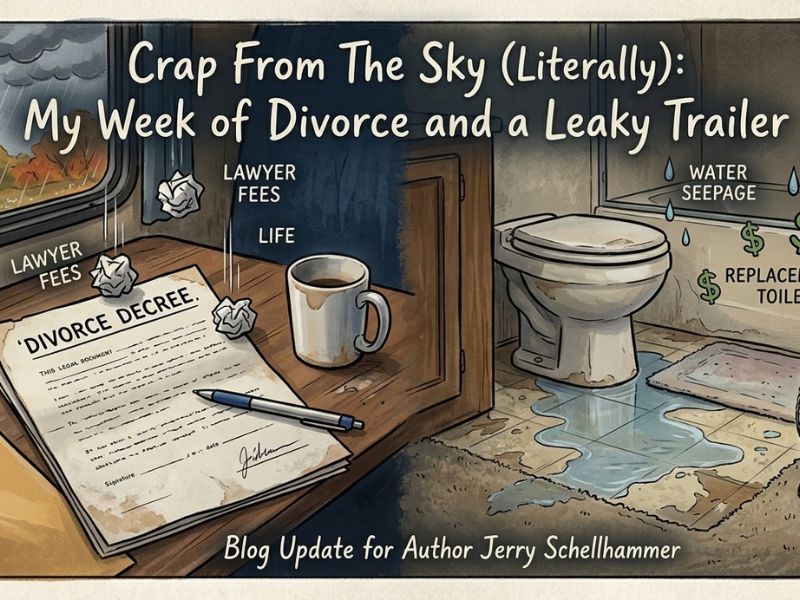
It’s been one hell of a week I’ll grant you that. Sorry my loyal readers for not reaching out to you earlier. It does seem like events occur by luck or fate, in terms of threes. This past week was no exception. Remember the Clint Eastwood Spaghetti western, The Good the Bad and the Ugly? This would be entitled, Bad, Good and Sad.  

The bad first. Sunday evening Tommy wanted to eat his kibbles. I was busy texting a friend when he wanted in and really wasn’t paying attention to how late it had gotten. As many of you know trailer doors push out and pull in to shut. It was a warm evening, and it started to be comfortable inside and just closed the screen door behind Tommy when he entered the trailer. 

At 8:30 I then realized I was getting tired and needed to retire for the night and realized the front door wasn’t secured yet. So, I went to open the screen door and secure it to the main door, then I could close both and be safe and sound for the night and go to bed. 

Tommy apparently decided it was a wonderful opportunity to go out and do some more exploring of the great five acres, maybe get another mouse or something. He flew out just as I opened the screen door and skedaddled.  

I spent the rest of the night calling for him or waiting for him to show up at the door meowing to be let in. It didn’t happen and of course I concluded after one in the morning he had fallen victim to the same coyotes who got Cosmo and Darla twice before. 

I spent the rest of the week telling my social media friends and my family along with work mates that once again I lost a cat. So, imagine my utter complete surprise when I came home Saturday afternoon from work hearing a distinct Tommy meow, meow coming from beneath the trailer.  

Besides being hungry and dehydrated, which I remedied as soon as I pulled the dishes from the trailer’s basement, he was in remarkably good shape. No war wounds that I could tell. He was sneezing more than normal, but considering he was out in the open probably got his nose full of pollen from the trees and flowering plants nearby. 

My theory is he was chased up a tree by that same family of coyotes. They apparently tried waiting him out so he could have an easy meal of him. But what they never figured from a domesticated cat was his preference for catching and eating bugs that he’s done since I got him from the shelter over a year ago. Happy couldn’t begin to tell you how I felt, along with Tommy who was equally happy that he found our home. 

On Thursday, our crew was called in to the meeting area from our supervisor. She informed us that one of our favorite coworkers was on life support. According to her, he was at a bus stop waiting to go to a doctor’s appointment, when he suffered a seizure. The same episode occurred last December at work. At that time, he was in good hands because our casino has top notch EMS staff and he was quickly taken by ambulance to the hospital. 

This time he laid on the cement sidewalk for over two hours in ninety plus degree weather directly under the sun before someone finally bothered to call 911 to report an unresponsive person. 

I’m sure all of us prayed that as soon as his mother came, he would awaken from his coma and be his old self again. But Knute Rockne moments only happen in Hollywood. On Sunday, his mother came and signed off on the end-of-life form and life support was removed. At 10:30 our supervisor called us all in and told us he had passed away. 

To know Htun was a privilege we all had. He always had a smile on his face and loved to give everyone a hard time. He would do anything for you and loved showing us pictures of his four-year-old son. He never had a bad thing to say about anyone. He will surely be missed. Rest `n peace my dear friend. 

New Book Release:
Four Seasons Book Three: Evil That Men Do
Check it out here:
Amazon

Hot Rod Lincoln

The heat above the track didn’t just rise—it shimmered. It was a midsummer night, long past midnight, and only the headlights of two powerful cars cut through the darkness as their V-8 engines rumbled. Beyond them stretched pitch-black emptiness and a sky crowded with stars. 

Hector sat strapped into the stripped-down cockpit of the Lincoln, his chest pinned by the four-point harness. The air smelled of raw gasoline, hot oil, and the copper edge of adrenaline. He glanced at the rearview mirror, where his Tia’s wooden rosary swung in tight, frantic arcs against the metal bracket—a sharp contrast to the stillness of the staging lanes. She would be proud of what I turned her papa’s car into. 

Outside, the track announcer’s voice crackled through a blown speaker, but Hector barely heard it. His eyes stayed fixed on his flag holding cousin down the strip. 

To his left, a rich kid from the north side blipped the throttle of a brand-new 1980 Chevy Camaro Z28. The Camaro purred with expensive, sterile precision—the kind of car bought with a father’s signature at the dealership. 

Hector looked at his dashboard—or what remained of it. The plush leather and faux-wood trim of the ’51 Cosmopolitan had been hacked away years ago with a Sawzall. In its place were raw sheet metal, a fuel-pump toggle switch, and a huge Autometer tachometer hose-clamped to the steering column. He had built this beast in the dirt lot behind his uncle’s salvage yard with scrap iron, swapped parts, and bleeding knuckles. 

He tapped the gas pedal. Through the crude hole cut in the hood, the massive 460 V8 cleared its throat. White fender-well headers dumped exhaust directly onto the asphalt beneath his boots. The sound wasn’t a purr but a hard, metal-shaking chop that thudded in his chest. The entire 4,000-pound tank rocked on its leaf springs with every pulse. 

The track marshal waved them forward. 

Hector rolled the Lincoln into the water box, set the line-lock, dumped the clutch, and hammered the throttle. The massive Mickey Thompson slicks spun at once, exploding into a blinding cloud of white smoke that swallowed the car. Burning rubber flooded the cabin, intoxicating and violent. He released the button, and the Lincoln bit into the track and lunged into the staging box, spray-painted white by his cousin Roberto. 

He crept forward. His cousin stood between the lanes, straddling the stripe with a yellow flag raised. A folded green flag hung in his left hand, and both drivers stared at it. 

The Camaro crept up.  

Hector exhaled, his hand resting on the white Hurst shifter ball. He nudged the Lincoln forward an inch. Roberto flicked the yellow flag. Hector staged. Sweat ran freely from beneath his helmet, tracing his jaw, and pooling on his gray V-shirt. 

Beside him, the Camaro staged. His father a rich farmer owned an Avocado grove. He was Mi Padre’s favorite. 

The world narrowed to two yellow flags Roberto held tightly in his right hand  and one green in his left. Hector held the engine at a screaming 4,500 RPM. The Lincoln strained against the brakes, its straight axle high, nose tipped skyward like a weapon. 

Yellow. 

Yellow. 

Green flag waved frantically side by side. Hector dumped the clutch, and the car lunged forward. He grabbed second, then third, eyes flicking from the tach past 2,000 RPM to the girl at the finish line waving the checkered flag—the girl he wanted, rushing closer in a blur of heat and speed. 

The Camaro stayed with him, edging closer as if it was about to pass. Hector pressed the clutch one last time to shift into fourth when a horrible sound tore out from under the hood. 

Black and gray smoke burst up, and Hector knew instantly he had lost—the race and the girl he wanted. The Camaro shot past as his Hot Rod Lincoln limped to the shoulder of the abandoned highway south of Tijuana. 

Aftermath 

The tow truck brought the rod into the wrecking yard where his uncle unlocked the gate and Roberto drove the truck passed the opened gate and into the yard where skeletons of every make and model resided in this vehicle graveyard. 

Hector pulled himself from the truck’s passenger seat, slamming the door with rage and passion his uncle knew from his brother’s Hector’s deceased father. 

“I take it the race did not go planned,” Alberto expressed soberly. 

“I lost Uncle! That’s all I want to say right now.” He flung his helmet out to the yard, striking the hood of a Cadillac Seville. Dawn was breaking in the east the shepherds who guarded the salvage yard barked menacingly at Hector. 

“Shut the hell up!” He yelled at them. 

“Hector, at ease, and that’s an order!” Alberto commanded in his USMC Gunnery sergeant voice. 

Hector looked at the car, still hooked up and steaming. The smell of burnt oil was heavy in the air. He began the process of lowering it to the ground and unhooking the chains from the Lincoln. Once he finished he, Roberto and Uncle Alberto pushed the car back inside the shop. 

Overhead fluorescent tubes lit up the moderate sized garage where other old relics are in various forms of repair or cannibalism, from a Plymouth Belvedere, Ford Galaxy and Buick Electra. They used their combined strength to slow the Lincoln to a stop. 

Hector raised the hood. The stench, a mechanical odor that reminded them of death. Hector began tearing into the engine grabbing his wrenches and sockets to begin the process of tearing the engine down to that point where the autopsy would reveal its cause of death on that quarter mile stretch of deserted highway. 

“You can get into that after you’ve rested. You’ve been up all night, Hector,” Alberto told him. 

“I’m not tired uncle,” Hector replied. 

“I’m not asking Hector. You will go to your room and go to bed. In six hours, you can come back here and take the engine apart and discover what happened. Then you will replace, repair, adapt and overcome. Go to bed now. That’s an order.” 

Hector wanted to throw the wrenches throughout the shop. His temper felt so intense that he needed to let off steam. But the only way he knew how was broke down and in need of repair, his Hotrod Lincoln. 

Hector placed the wrench on the flat black fender and walked to the stairs and went up the steps one step at a time. His thoughts a whirl on conflict, wondering what if I’d done this or that.  

He went into his room and laid on the mattress. He was fully clothed and he stared up at the ceiling. In due time his eyes grew heavy, and he fell asleep from exhaustion. The adrenaline of seven hours ago finally drained and sleep overtook him. 

Cause 

Hector awoke hungry at around 4:30 later that afternoon. An aroma of chorizo chopped onions and peppers wafted up to his room. He pulled himself out of bed, undressed and went to the bathroom where he took a shower to get his motor running. He continued thinking what went wrong, where he messed up at and what he needed to fix it. 

“It’s not like I don’t have another engine that I can just throw in that car. The wrecking yard is full of engines. But that was so perfect and sounded so badass.” He finished rinsing and shut off the taps, stepping out from the tub and drying himself as he made his way back in his room.  

After he dressed he went downstairs to the main part of the casa, a simply built structure that at one time was a barn that his uncle bought but converted into an adobe house. Tiled floors, cool to the touch of his bare feet greeted him. Tio Alberto spared no expense on the renovation adding modern appliances to the kitchen.  

His focus at that moment wasn’t on how the rest of the house looked or how it aesthetics pleased his eyes, but on the skillet in front of his big-bone Tia, Rosa. She smiled warmly at her nephew. “Hector, it’s good to see you awake and refreshed. Alberto told me about the race last night. I’m very sorry for your misfortune. Will you be able to repair the problem?” she asked him in Spanish. 

“Yes, Tia, I intend to go in and check the entire engine and hopefully I can fix it. But I can always find another motor though I love this one.” 

“Of course you do. It’s your baby!” She scooped up the concoction with a side of rice and black beans onto a plate and handed it to him. “Eat well, Hector. There is more if you want.” 

“Gracias, Tia Rosa,” Hector replied and went to a simple pine plank table, crossed himself, said a silent prayer of thanks to Our Lord and Savior, and began eating his breakfast lunch and supper. Heated tostados sat on another plate that he grabbed and rolled up, adding hot peppers and onion salsa with the beans and rice. Rosa set a cup of coffee next to his plate just as Alberto and his cousin Roberto walked in from a side door where the wrecked and broken-down cars sat. 

“Are you ready to tackle that project now Hector?” Alberto asked. 

“Yes, and I am sorry I was so upset this morning,” Hector replied to the large man as he sat at the table and waited on his wife to serve him his supper. Roberto sat next to Hector. Both he and Alberto crossed themselves and silently prayed Thanks then they proceeded to eat the meals in front of them. Rosa finally sat down and did the same. 

After supper, the three men went into the shop and began removing the engine parts, one by one, inspecting each piece, determining if this or that was the culprit. Finally, after removing the head on the driver’s side, Hector discovered the cause, a bent push rod that once it fell to the shop’s cement floor broke in half. 

“Roberto, go find another push rod that is this exact measurement,” Alberto told his son. 

“Si, Papa.” Roberto went outside to where other engine parts laid about on a long table, taking with him another pushrod that was still good. He smiled good-naturedly at his cousin before disappearing outside. 

Alberto looked at the head closely. “That isn’t the problem, Hector but a symptom of a larger problem. See here, this valve is still open as if the oil didn’t reach the spring to close properly in time. You ran at such a high RPM, it could have caused this to happen,” he explained to his nephew.  

“Check this too: Rocker arms and rocker shaft — Look for worn pivots, broken springs, loose mounting hardware, or damaged rocker tips. Valve springs — Check for broken coils, weak tension, or collapsed springs. A weak or broken spring can allow valve float, which can bend a pushrod. Valve stems and guides — Ensure the valve moves freely and isn’t sticking; a stuck valve is a classic cause of pushrod bending.  

“Other pushrods — If one bent, others may be worn, cracked, or beginning to deform.” 

“This is going to take some time, Tio.” 

“You don’t race again until it’s fixed, Hector. Be patient and treat this like a grandfather clock. It must be treated with the utmost respect and love.” He gave Hector a shoulder hug showing a big toothy grin beneath a heavy black mustache. Hector bore the same smile and returned the hug. “Check the timing chain and camshaft too, Hector.” 

“I saw an F-250 came in the other day, Tio.” 

“It’s has a 429, I know. If we have to we can swap out many of the components including the head.” 

“But will it be race ready?” Hector asked more to himself than his uncle. 

“That is up to you, Hector. Start tearing the engine down further and if it is part of a larger problem, which it undoubtedly is, then we can always swap out the engines and begin gearing it and timing it make it worthy for racing.” 

“Yes, Tio, I will continue the process.” 

“Sorry Cousin, no luck finding a match for this particular pushrod,” Roberto expressed with disappointment in his voice. 

“That’s quite alright, Roberto. Hector is going to inspect the motor further. Go out to that truck we brought in the other day, the F-250 and start tearing it down.” 

“Si, Papa,” Roberto said as he grabbed his personal toolbox and left them. 

Throughout the majority of the night, the tedious process continued until Hector discovered the actual cause, which was: Valve float at high RPM — Valve stayed open too long, which caused the piston hit it, and the force buckled the pushrod, hydraulic lock (fuel in the cylinder) — Piston compressed fluid, pressure forced the valve open violently, bending the pushrod, and improper valve adjustment — Too-tight lash or aggressive cam profiles overloaded the pushrod. 

Hector found similar issues with the seating and the valve springs set too tight. “How could I have been so stupid?” 

“There are reasons, Hector why you read the manual and make the proper adjustments within its limits, or this can happen.” 

Hector listened to his uncle but didn’t reply. A steely eyed determination set his face into a stone-cold sober expression. He left the shop and walked outside to get a breath of air. It wasn’t fresh by any stretch, but it was a way of him to cool his temper and not lash out at Uncle Alberto. “It’s not his fault I messed up, but mine. All Mine!” 

New Attitude 

All three men worked their normal jobs scavenging parts to sell to other motorheads in the southeastern portion of Tijuana area. The surrounding barrios gave them a lucrative business from outlaw street racers and dragsters to low riders to vaqueros with their beaten-up Ford or Chevy or Dodge pickups, sometimes with bales of hay on the bed. 

At night after they ate their simple supper they went into the shop and set about rebuilding that engine. Hector learned his lesson by not overdoing the tolerances set forth by the Chilton catalog specs. He used the torque wrench and calibrated it to the absolute micrometer of tolerance. 

Two weeks they methodically rebuilt that motor until it appeared ready. They set it on a stand, using a battery from another vehicle, an ignition button and a prayer, they did the first test start. It made a horrendous unmuffled explosive burst of power. The shop doors were opened to allow the exhaust to escape outside. The 429 was ready to be mated to the Lincoln’s four speed transmission. 

The dogs outside started barking in a menacing tone warning them there was someone at the gate. Roberto grabbed his .32 revolver and investigated. Hector and Alberto moved the engine stand with the new engine to the Lincoln. Both heard the exchange of Roberto talking to whomever the stranger was. 

“You are on private property esse,” Roberto told the person in Spanish. 

“You don’t know who I am, amigo?” 

“No, you tell and I won’t shoot you in the head and feed you to my dogs.” 

“Where’s Hector? He’s the one I need to talk to,” the woman’s voice replied. As soon as Hector heard his name, he perked up and walked carefully to the shop’s entrance and looked outside at the gate where he spotted Sanchez’s girl Maria, the flag girl from nearly two weeks ago. 

“I’m Hector. What do you want? This ain’t your territory! You should go back to the northside where you belong, among your rich farmer friends.” 

“Carlos wants to challenge you again. He felt sorry for you for losing the way you did,” Maria told him haughtily. “He will be more generous this time.” Laughter was heard in the shadows obviously Carlos Sanchez was waiting in the car while she talked bravely to him and Roberto. 

“Why don’t he come out of his dad’s fancy car and challenge me himself? Or is he too much a coward to face me like a man?” 

Roberto glanced at Hector with a sense of nervous anticipation in his eyes. “Cousin?” 

“Okay, asshole, here I am,” Carlos announced in a loud and obnoxious tone that matched his husky body type. Hector saw his face was concealed by the streetlight shadow off his white cowboy hat, obviously handmade and tailored for his large head. His jeans and button-down checkered shirt screamed Northern Tijuana where all the rich Mexicans lived in their orchards, groves and vineyards. “You got balls to take my challenge?” 

“Yeah, I accept your challenge. Let’s raise the stakes a little higher this time.” He walked out to the closed gate where Carlos, a much bigger man than Hector stood looking down at him with a sneer on his mouth. 

“Yeah?” 

“Yeah, let me take your woman for a night. By the time I’m through with her, she’ll forget all about you!” Hector and Roberto laughed. 

“You mother—” 

A click of the pistol’s hammer coming back cocked, stopped Carlos in his tracks. He smiled ruthlessly at Hector. “Sure, why not. She won’t mess with your kind anyway.” 

“Probably not your kind either,” Hector opined glancing at the indignant Maria. “Isn’t that right Maria?” 

She gave both a pouty face expression and stormed to the Camaro, slamming the door behind her. 

“God dammit! I told you no slamming the door!” Carlos yelled after her. “Same place Saturday night after midnight, Gonzales!” He backed himself up to his car, got inside and backed up, turning right and then peeled the rear tires on the asphalt road, heading back north. 

“Looks like you got your work cut out for you, Hector.” Alberto stated as he came up beside him. 

“Yeah, but I know I can beat him.” 

A Visitor 

Saturday morning, the dogs barked warning the Gonzales men someone was at the gate. They all finally finished with the final tuning of the Lincoln and had gone to bed well after midnight. It was a little passed seven, according to Hector’s old fashion alarm clock with a pair of bells on its top. 

“Who could that be?” Alberto asked his wife his voice carrying throughout the casa. Hector quickly threw on his pants and grabbed his personal .38 revolver on the nightstand next to the clock and followed Alberto and Roberto downstairs. Rosa looked with concern at all three men as they passed her and went through the shop. 

“Ola,” a familiar voice resounded while the three men greeted the morning with sun blinding them as they ventured cautiously toward the gate where a soldier of the Mexican Army stood at parade-rest waiting to be let in. He had the rank of Lieutenant on his collars, and aviator wings over his nametag over his right breast pocket. 

“Geraldo, you stupid son of a bitch,” exclaimed Alberto who stopped, placed himself in the position of attention and saluted him. Geraldo returned the salute, grinning like a fool. He waited while Roberto gathered the two dogs, hell bent to have him for breakfast and Alberto opened the gate to let Hector’s brother inside. They both hugged the helicopter pilot then they went through the shop. 

Geraldo admired the Lincoln parked inside before continuing into the main house where Rosa greeted him with a tearful hug. “How is everyone?” Geraldo asked with enthusiasm in his rich baritone voice. 

Soon Roberto joined them and they all sat at the dining table, Alberto began, “What brings you to our humble casa?” 

“I’m on leave before my final mission and hitch is up. I even have a job when I get out. I’m going to be a Federales Policia and flying helicopter for them,” he boasted to the cheers of the family. 

“I’m so proud of you nephew,” Alberto stated with an emotional tug to his voice. Though Hector also felt pride for his older brother, he also felt a twinge of jealousy. 

“I congratulate you brother,” Hector told him as he slapped his large shoulder. 

Geraldo turned around and smiled at Hector. “You need to make something of yourself too, Hector.” 

“I intend to,” he replied defensively. 

“What? Build dragsters and hotrods? That is not planning for the future, brother.” 

“I tell you what, I bet I will be as successful if not more so than you,” he half seriously jibed. 

“Oh, really,” Geraldo laughed. “I doubt that very much.” 

“Sounds like a family wager to me,” Alberto told the two. “How much?” 

Hector looked right at Geraldo and replied, “I will wager five hundred pesos.” 

“Let’s make it more interesting brother, sixteen hundred peso,” Geraldo upped the ante. 

Hector showed no fear as he drew his hand out to shake with his brother. He quickly clasped his big hand over Hector’s, and they shook on the deal.  

The family laughed at the exchange. “By the way, I too have news to share,” Hector told his family after releasing his grip from his brother’s. “I was going to surprise everyone at the end of the month but, I enlisted in the United States Marine Corps, just like Tio Alberto.” 

The place seemed deathly quiet, as if he mentioned something forbidden. Everyone stared at him as if he was kidding, but Hector’s straight-lined mouth and sober expression revealed that he was serious. 

“When did you do this?” Alberto demanded. 

“Last month, I decided I needed to plan on my future as well. Geraldo’s right, I need to show myself to the world and building hotrods and street racers is not going to do that. Unless of course I emigrate to America and be lucky enough to get hired by a drag race team, and what are the odds of that happening to someone like me?” 

Everyone looked to Alberto for his blessing. He slowly sat down, ruminating on this news. He finally looked at Hector and smiled, “God bless you and our family. You both have made me very proud. I just wish your parents could see this joyful moment.” They all crossed themselves reverently. 

After breakfast, Hector and Geraldo took the Lincoln out for a brief spin in the hills overlooking the Tijuana skyline and its panorama views of Northwestern Mexico and in the distance a hazy view of San Diego. They put the Lincoln through its paces, though it was nothing compared to later tonight. Hector tried not to think about that while they both leaned against the hood and saw the boundary of the north and south by the quality of the homes each side lived on. 

“You made Uncle Alberto proud, Hector. I think he wanted Roberto to follow in his shoes, but you beat him to it.” 

“Roberto tried talking me out of it,” Hector replied. “I think maybe he did want to enlist. I don’t know, I think up here,” Hector pointed at his head, “Roberto may not have what it takes to be a good Marine. I don’t know if I have that either, but I have to do something other than sell automobile parts to make a living. Roberto is a natural at what he’s doing now. I can’t do that.” 

“What about after? Are you going to go into something else related to the military?” 

“I haven’t thought that far ahead, Geraldo.” 

“Law enforcement is always a good option. It’s what I’m doing, abet as a helo pilot.” 

“Just be careful, brother. I want to collect on that bet,” Hector punched him in the shoulder. Geraldo punched back nearly knocking him to the ground. 

“I intend to, brother because I too intend to collect on that wager, so you best be careful as well.” 

The Race 

High winds kicked up lose sand granules flinging them into the faces of the lines of bystanders along each embankment of the same abandoned highway as two weeks ago. 

Hector drove his Lincoln to the sprayed painted white starting line. The Camaro was already in position. He wore his helmet with goggles to help keep the blowing sand out of his eyes. He looked across at the newer car and noticed Maria sitting in the front passenger seat next to her beau Carlos. 

“Who’s going to be the flagger?” Hector yelled across at Carlos amid the ground shaking rumble of the two powerful motors. 

“Roberto will flag!” Carlos yelled back at him. 

Geraldo came up to Hector’s driver side. “Is there a problem?” 

“Yes, that bitch over there in Carlos’ car isn’t flagging tonight,” Hector replied dismayed. 

“It’s all good. I will wave the checkered flag. Is Roberto going to wave the yellow and green flag?” 

“Yes, that was the idea until this came up,” Hector told him with building frustration in his eighteen-year-old voice. 

“Chill man,” Geraldo tried soothing his brother’s emotion. “I’ll grab the flag and run down there. Is there a finish line?” 

“Yes, it too is spray painted white. You can’t miss it.”  

“Senors and Señoritas, tonight we have the rematch of the century!” The MC announced through his bullhorn. “Inside the brand new 1980 Camaro, CARLOS SANCHEZ!” Carlos revved the small block V-8, though muffled still sounded impressive amid cheers from the northside crowd. 

“And in the 1951 Lincoln Cosmopolitan, give it up for HECTOR GONZALEZ AND HOTROD LINCOLN!!!” It was his turn to rev the new 429 V-8 big block that sounded like the demons from hell unleashing their fury on mortal man. The ground vibrated with a sinister sound not heard in years. The southside barrio crowds roared as loud if not louder than the Lincoln’s rumble. 

Both cars heated their tires, peeling out and stopping before backing up. Hector felt the adrenaline firing off inside his body as much as each spark plug fired off on his rod. He did his best not to show the anticipation, trying to just focus on Geraldo, who he barely made out in the darkness. Two men on each side of the highway shined their flashlights along the same finish line. Roberto got his cue from a man in black coat and bow tie. He wore a top hat. Roberto raised the yellow flag to signal stage one. Both cars moved slowly to the starting line.  

Roberto then waved the yellow a second time, and both cars revved their engines loud, LOUDER, LOUDER.” 

Roberto then waved the green flag, and both were off at the same time. A rush of climax hit Hector as though someone hit him between the eyes as he shifted rapidly while the tachometer needle hit 2,000 at each upshift, finally reaching fourth gear and screaming to the finish line. 

He barely noticed the Camaro as it just passed him at the finish line and saw his taillights. “Damn, I lost,” Hector exclaimed in disappointment when the unimaginable occurred. Hector couldn’t believe his eyes as the car in front of him abruptly went sideways then end over end and exploded in an orange ball of flame. Hector quickly skidded to a stop and shut off the car. He pulled himself from the opened window and ran as fast as he could to the burning wreckage.  

Geraldo passed him by and got there first. He pulled Maria out from there and laid her along the embankment. Hector got there just in time to see Carlos inside trying to escape the flames that quickly engulfed him. 

Hector tried pulling him out, but his harness prevented that and the nightmare continued as he heard Carlos’ screams of pain and agony until deathly quiet flooded the night with its zephyr-like winds. The flames continued unabated until a firetruck arrived and the firefighters put out the flames.  

They left Carlos’ body inside and local alguacil dispersed the crowd, all of whom were shocked beyond measure at the horror they witnessed. 

Dawn broke and Hector sat inside his car. An ambulance took Maria to the hospital. He had no idea how serious her injuries were, though she was conscious and asking, pleading for Carlos. Roberto and Geraldo stood next to Hector, leaning on the flat black painted car with her name stenciled along its side. 

“Let’s take her home,” Hector told the two. 

End 

Strange People

It’s me, Tommy, you know Master Jerry’s cat. Elsa and I had this strange visit the other day by these strange people that just came in out of the blue. At least I wasn’t aware they were coming. It does explain Master Jerry’s strange behavior before they arrived. 

You see, he busied himself for four days cleaning our home. I stayed out of his way, naturally since I didn’t want him stepping on my tail or something. So, I was outside most of the time while he was inside doing whatever humans do to make a fuss over what I thought is a waste of time. 

Anyway, whenever I came in on demand, then left on demand, I noticed a portion of home wasn’t just wiped down and organized, but clean. Clean, Clean, CLEAN! 

It made no sense to me, after all I’m perfectly content to allow our home to be as it is just as long as my litter box is clean. Elsa concurs that so long as she is fed she is happy. I noticed he didn’t clean her cage, though he did that last week. 

They showed up on a Friday, I believe it was. A bearded man drove a black truck onto my territory. I simply tolerate the dog named Amber and the other humans who lives here, but my heckles raised when I saw this truck stop and the man and blonde-haired woman pulled themselves from this truck and began walking toward my trailer, our home. Who are they? Why are they here? What are they doing?  

I snuck underneath the trailer and overheard Master Jerry talking to these strange people. I listened but didn’t understand what the woman was saying or the strange man either. Master Jerry apologized he hadn’t finished cleaning the bathroom yet. 

Bathroom? That glass cub that sprays water inside, making him wet then come out smelling funny? Or is that room he calls a water closet where the vacuum and mops and brooms are stored along with his litter box or that sink? Who cares! 

I heard them talking some more then everyone came out and walked to the vacant lot that Amber and I like taking walks on to catch mice and birds. I stayed hiding in plane sight while I heard them talking about where they were going to sleep tonight. Something about putting a tent up on back of the pickup. 

I finally went near enough to them to get a good whiff of them, but it wasn’t anything I was familiar with. Perhaps their odors were different for some reason. At any rate, the woman seemed more attached to Master Jerry than the man. Could they be related? The question hung in my curiosity until I came up to Master Jerry and asked who she is.  

“That’s my sister,” he informed me. Somehow he has this uncanny ability to interpret what I say. He smiled down at me and sister wanted to reach down and pet me, but I would have none of that. I hissed at her and ran underneath the trailer. That will teach her. 

They still haven’t left yet! Why don’t they go? They’re doing something called a barbeque, whatever that is. I watch them sitting on lawn chairs talking with the other people who live here. Master Jerry is playing with the little boy they call Evan. I avoid him too. He wants to play but I rather hunt mice. Bird! I see a bird. I crouch down and slowly move toward it. And then I pounce on him. He puts up a fight and tries escaping me. Everyone is watching me now, watching me play with it as it tries flying away and I leap on it.  

Amber wants in on the fun too, but I won’t let her. We have him cornered and the little boy wants in now too. I hear the woman called Momma or Emely tell them to let me put it out of it’s misery. How do I do that? 

Master Jerry and sister go into the trailer, the silver dome shaped thing on wheels Jerry rolls out to the door. The man he calls Nick hefts a cylindrical bubble looking thing over and attaches a hose to it and then it’s turned on.  

Master Jerry turns a knob and pushes a button, and I hear a whoosh sound and smell rotting eggs emit. I hide under the trailer and wait. A few minutes later I smell meat. I love the smell of meat and am happy that Master Jerry is cooking meat. I hope he gives me some. 

But he doesn’t and I’m stuck eating kibbles out of my dish instead. I stare at her and him wondering what they are doing and why they haven’t left yet. She keeps talking to me to come over and let her pet me. But I’m not going to give her the pleasure. 

Instead, I just stare at her waiting for her and that Nick man to get up and leave. As far as I am concerned, they have overstayed their welcome and need to go away, so I can relax and hang out with Master Jerry and Elsa. Oh, they are leaving! How sad, and we just hardly met. Bye Bye strange people! 

Under The Bridge

“You got the shit?” The angry appearing Black man sneered at the dwarf with big mutton chops and one patch over his left eye. They rendezvoused at Monroe Street Bridge. The Hunter’s Moon was full and white and bright; there was no need for streetlights as the satellite showed everything this October night a little after midnight. 

“Why certainly,” Howard said with a phony Chicago accent, but this man wouldn’t know the difference. He held up a book pack that he borrowed from his daughter to do this deal. “Just out of curiosity, who is this for?” 

“Ain’t none of your business!” He snarled back at Howard the undercover FBI agent dressed in jeans and an overcoat with a fedora similar to what Mark normally wore only black. 

“Like I said,” Howard said in a soothing tone to calm both their nerves. “I’m only curious. It isn’t Nick, or Bob is it?” 

“Who the hell you talking about cracker? No, it ain’t none of them dudes. “It’s Bates, okay?” He looked at Howard with suspicion. “You a cop?” 

“No, I’m Ramrod, your neighborhood dealer, making sure neither Nick nor Bob are going to get this. It’s enormously powerful stuff. They couldn’t handle it.” 

“You are a crazy mother fucker man! Here’s the money, take it before I change my mind!” 

“Is it all there?” Howard asked. 

“Five big just like we agreed to over the phone!” 

“FBI you’re under arrest!” Boomed the unmistakable voice of Special Agent Mark Marteau while spotlights drowned out the moonbeam that cast down on them a brief second ago. Hector led four other agents and Spokane narcotics task force officers on them quickly, cuffing both before a shot could be fired. 

“There must be some sort of mistake,” Howard informed the arresting officers who manhandled him into a waiting Ford Crown Victoria unmarked police cruiser. 

“Oh, it’s no mistake, you piece of shit scumbag,” Mark told him as he watched Howard being pushed inside and the back door closed. Hector and Chester got into the front seat and drove from the scene. 

“I say, we got that small fish, but we need the barracuda,” Howard told them. 

“Or the shark for that matter,” Chester agreed. “You’ll still have to play your part in the cell until interrogation.” 

“I’ll try my wonderful charm on him some more.” 

“Who’s Nick and Bob?” 

“Friends I knew when I was growing up in Boston, Hector. Unfortunately, they are no longer with us.” 

“Sounds like a story to me,” Chester goaded Howard. 

“I suppose we have time to tell this tragic tale.” 

“You ain’t going to go all Shakespearian on us are you?” Hector asked with dismay. 

“Perhaps, but it is something I’ll never forget for as long as I live.” 

“Begin,” Chester coached Howard. 

“Very well but be a good man and undo these cuffs until I’m done.” Hector pulled off a side street and into a back parking lot behind a business building. He parked the car while Chester got out, opened the back door and uncuffed Howard who rubbed his hands gratefully. 

“Get on with it already.” 

“Bob and Nick were close friends of mine in college. We were freshmen then and seemed to have the tiger by the tale. I went to Boston College then. Obviously, we imbibed too much and did things I hope my daughter doesn’t do that would keep me up at night. 

“At any rate, all three of us lived in the same dorm. I had plans for majoring in psychology and being a counselor, Bob was a science nerd and intended to move up the ladder to MIT and get his masters and PHD there.” He paused a moment trying to gather his thoughts or relive this memory.  

“Nick, dear Nick was an up-and-coming poet and writer. He was already published through magazines in Boston and New York. We laughed until he showed us the cancelled check from Playboy of a story they published and it had nothing to do with sex but about some lad coming of age. 

“But I digress. The story itself is a tale that I have kept hidden in the deepest and darkest recesses of my mind. It was, oh hell when was it? It must’ve been after our second semester started and we were watching Miracle on Ice at the Olympics in New York. Lake Placid I believe it was.  

“We were all just besides ourselves in an abundance of joy and too many beers, possibly marijuana too. On a whim, we walked—most likely we staggered to the Longfellow bridge at the Charles River. 

I had a jug of wine in my gloved hand, wandering the mostly empty street. It had snowed recently and snow berms as high as Chester were going along the street and blocking my view of my chums who decided to traverse that berm and play king of the hill, pushing each other off and having a grand old time. I naturally stayed below and watched them.” 

“Were they small like you, Howard?” Hector asked still in the driver’s seat. The Ford sedan idling. 

“No, quite the opposite really. I believe Nick was around five-ten and Bob was a tall gangly fellow over six foot. They frolicked and then we saw these rascals down the street coming towards us.  

“I don’t recall who saw who first, maybe it was at the same time. They were quite young, this gang of thugs. They wore their colors proudly displaying Red Sox ball caps worn sideways on their heads. 

“They obviously spotted me first and ran to obviously accost me, but Nick and Bob came down and stood next to me. They stopped on their tracks and began hurling insults at us apparently they were ready for a fight, which was why I never found out. 

“The biggest of this group came up to me and threw me into the snowbank. His friends laughed of course. I was fit to be tied but obviously couldn’t do anything more than use all my strength to right myself up. I then turned around just in time to see my friend Bob land an uppercut to the tyrant’s face and nose, seeing the effect as blood spurted everywhere on the street. Nick took care of the other youth who tried but failed to put up a decent fight. 

“Suddenly a pistol came out and a shot was fired. Bob fell next to me and Nick stood there frozen in place. The gun in his hand. The other gang ran off. 

‘Oh, dear God,’ “Nick shouted out in disbelief. ‘Are you okay?’” 

‘Why are you holding that gun?’ “I shouted at him. Bob was conscious but moaning in pain.” 

‘It’s for self-protection,’ “he told me. He still held the gun, a revolver I believe it was. 

‘Go to the neighbors and tell them to call the police,’ “I told Nick, hoping he’d put the gun down and do what I told him. He ran down the street instead, obviously in a panic about what he’d done. He ran to the bridge.” 

‘Wait, come back here,’ “I cried out to him. By then I finally got myself out of the snow berm and upright looking down at Bob. I immediately assessed his wound. Blood soaked out on his coat and from his stomach. I knew it wasn’t good but figured he would survive. 

“So, I went to the neighbor’s house across the street and banged on the door. An elderly woman in her housecoat and slippers answered the door hesitantly. I asked her to call the police to say that my friend had been shot and needed immediate attention. It was then I heard the other shot coming in the direction of the Longfellow Bridge and the Charles River. 

“I don’t know what she said because I ran back out onto the street and in the direction of the shot, fearing the worse. I got there and didn’t see Nick. I didn’t see anyone. I then ran under the bridge and I then saw Nick, lying prostate on the ground with his eyes string vacantly into the substructure of piers and supports. The revolver lay next to him. A bullet hole was at the side of his head. I knew he was dead. 

“By the time I got back out of that bank and began walking back to Bob I saw the first of many police cars and ambulances arrive, there were emergency lights flashing everywhere. They wouldn’t let me see Bob and I found out the next day he had passed.” 

“Damn, dude, that’s tough,” Hector expressed with sadness in his voice. 

“I’m sorry for your loss too,” Chester said wrapping his big arm around Howard’s shoulder in a comforting manner. He then placed the cuffs back on Howard’s wrists and got out from the back seat, closed the back door and went and sat next Hector in the front seat. 

“There is a silver lining in all of this.” 

“Yeah, what’s that?” Chester asked. 

“A week later I changed my minor from theater to Criminal Justice, realizing I did indeed have a gift for what I’m doing now.” 

“You’ll always be an actor, Howard, as we all are I guess,” Hector told them as he placed the car into drive and whipped out from the parking lot and toward the Justice Center. 

Another Loss

Not that I enjoy expressing sad news to you my loyal readers, but this truly is where the cure is as bad as the disease. A hotel housekeeping supervisor who I have known for a few years passed away last week. I was off on the day it happened and so I learned about it fourth hand and not altogether certain how much I’m conveying is actually the truth. 

So, anyway this supervisor was well known and well liked by his coworkers and those under him. He appeared laid back and quite at ease with himself, exuding self-confidence.  I suspected that he was probably gay because that’s how he came across to me and everyone else, an effeminate approach to life in attitude and deed. 

Now, according to the person who told me what allegedly happened. He was sitting at his desk and closed his eyes. According to him, the supervisor had lost his kidney function resulting in renal failure. As I said, this is fourth hand information and I’m not the dependable narrator I like to be especially in the next paragraph because I am only hypothesizing here. 

He always, especially in the few months I ran into him as sickly, from what I can’t say with accuracy. I’m assuming this issue, if he indeed was gay, could be HIV, which if he was taking the prescribed medication has serious side effects that includes kidney function issues. 

For the most part, if a person does test positive for HIV, most modern prescribed medications are safe to use that help those infected lead healthy long-term lives. Just like with my dad though, when whatever ails you begin to affect kidneys and liver, your time above ground is limited no matter what medications out there can help alleviate the symptoms. 

My dad didn’t have HIV but type one diabetes and insulin that helped keep his blood sugar stable, also had really bad side effects. These side effects also included renal and liver disfunction resulting in death. 

“An ounce of prevention is worth a pound of cure,” paraphrasing Ben Franklin, though he was referring to fire prevention in home in Colonial Philadelphia, but I believe it applies here as well. Proper diet and protected sexual practices go a long way to not taking pharmaceuticals in the first place. 

Is it Real of Figment of Imagination

Lately, since I had my two novellas presented at the Los Angeles Times Book Fair, I received emails from individuals who represented publishing houses, and not just some small-time press or self-publishing printing outfit, but Random House and Gray Wolf Press. 

Ten years ago, I would be jumping for joy and thinking I just struck gold. Ten years ago, I was more trusting and less skeptical of these emails because everything looked so authentic. That was then and this is ten years later, and a lot has happened at that time. 

To start with bad players are everywhere doing everything they can to swindle you or me into believing that what I have is pure gold and all I have to do is say yes, and I will get a double serving of American pie. 

Secondly I am using AI to summarize these emails to verify their authenticity. The person from Gray Wolf, for example, used her personal AOL address rather than a hyperlinked email company address. That’s a red flag. After submitting to these two people my keen interest in more information from them, they never replied, which says a lot about how scrupulous they must be. 

Finally, I’m much more skeptical now. I don’t see things with wide eyed wonder and think that what I have is worth more than the book’s price on the bar code or ISPN. I’ve learned my mistakes from my past and don’t just say yes anymore. 

While I appreciate all he latest attention poured into my two books, I definitely don’t need to be swindled out of money or jilted by false platitudes of what an enjoyable book(s) I have written.