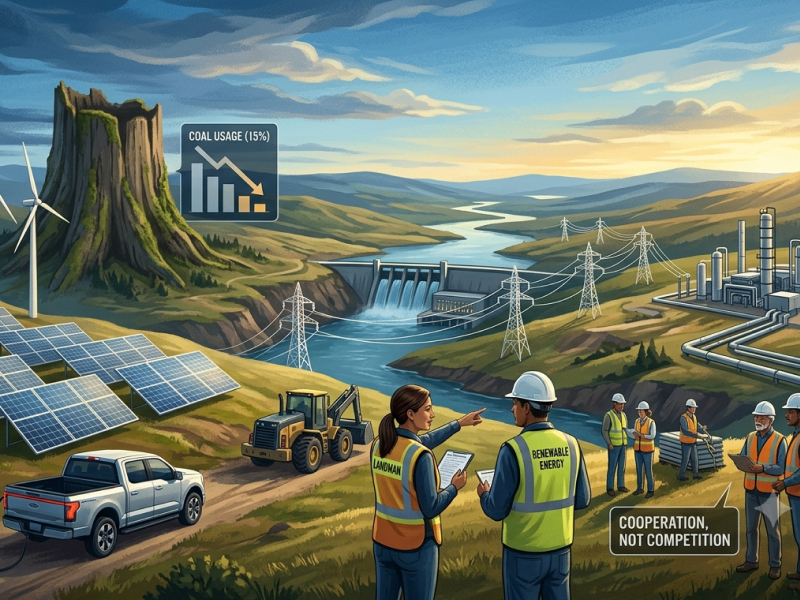
In an episode of Paramount’s Landman, Billy Bob Thornton’s character, West Texas oilman Tommy Norris, sharply criticizes renewable energy while walking through a wind farm. He claims that it would take twenty years for a wind turbine to offset the carbon footprint created by its construction, but available data suggests that figure is closer to several months. The scene raises a larger issue worth discussing: America’s energy future should not be framed as a fight between fossil fuels and renewables, but as a practical transition in which each sector must adapt, cooperate, and contribute to a more reliable and sustainable grid.
That practical transition begins with acknowledging two realities at once: renewable energy is now a permanent part of the American energy landscape, and oil and gas will continue to play a significant role for years to come. Coal, however, appears to be on a different path; like the ancient forests from which it formed, its place in the nation’s energy mix is steadily fading. It now accounts for just fifteen percent of U.S. energy consumption, and its long-term decline continues.
Solar energy illustrates why this transition matters. While panels, batteries, electric vehicles, and other technologies still depend on materials, manufacturing, and reliable charging infrastructure, the resource itself is abundant: the amount of solar energy reaching Earth in about an hour is more than enough to meet global energy needs for an entire year.
That abundance also matters because transportation electrification will place new demands on the power grid. Electric vehicles show how quickly clean-energy technologies can mature once investment, infrastructure, and consumer demand begin to align. Over the past decade, EVs have emerged as a viable alternative to internal combustion engine vehicles, despite early limitations in battery capacity, charging speed, and driving range. Rather than comparing every vehicle type as if it served the same purpose, the broader trend is clear: battery capacity, range, and efficiency have improved significantly across hybrid, plug-in hybrid, and fully electric models. EVs now come much closer to matching conventional vehicles in everyday performance, even though charging access, grid capacity, and battery supply chains still require continued development.
Hydroelectric power is especially meaningful to me because of my lifelong connection to the Pacific Northwest, where rivers and dams have long shaped the region’s identity and economy. Hydropower was America’s first major source of renewable electricity, predating the modern growth of wind and solar. Its flexibility and dispatchability also make it a valuable partner to variable renewables, helping create a more reliable and resilient grid.
Those who view renewable energy primarily as a threat to traditional energy jobs should instead recognize it as an opportunity for adaptation and investment. The relationship between fossil fuels and renewables is increasingly interconnected: solar arrays, wind farms, hydroelectric dams, transmission lines, vehicles, machinery, and maintenance systems all depend on skilled workers, reliable materials, and industrial support. Given the growing strain on the electrical grid, the better path forward is cooperation rather than competition—an energy economy in which all sectors contribute to greater reliability, stronger domestic production, energy independence, and long-term sustainability.

